
Pure SQL Chess Engine in DuckDB: Quack-Mate
Pushing the Boundaries of Chess in SQL
I know what you’re thinking: SQL is a terrible language for a chess engine. And you’re right. It is inherently designed for set-based data retrieval, not for the highly branching, depth-first search of chess engines. My intention with Quack-Mate wasn’t to dethrone Stockfish, but to explore a single, slightly mad question: just how far can we push a modern analytical database to play chess?
TL;DR: Is it possible to build a playable chess engine in pure SQL? Though it’s not trivial, the answer is “yes, with conditions”. Quack-Mate explores the inevitable collision between the set-based execution models of database engines and the sequential, depth-first reasoning required for efficient chess.
A playable compromise between these two opposing forces requires trading off both the algorithmic superiority of traditional engines and the raw data-crunching throughput of modern analytical databases. The result is a functional engine that proves an ‘unsuitable’ paradigm can be stretched to perform—and a clear-eyed look at exactly why the divide between sets and trees runs so deep.
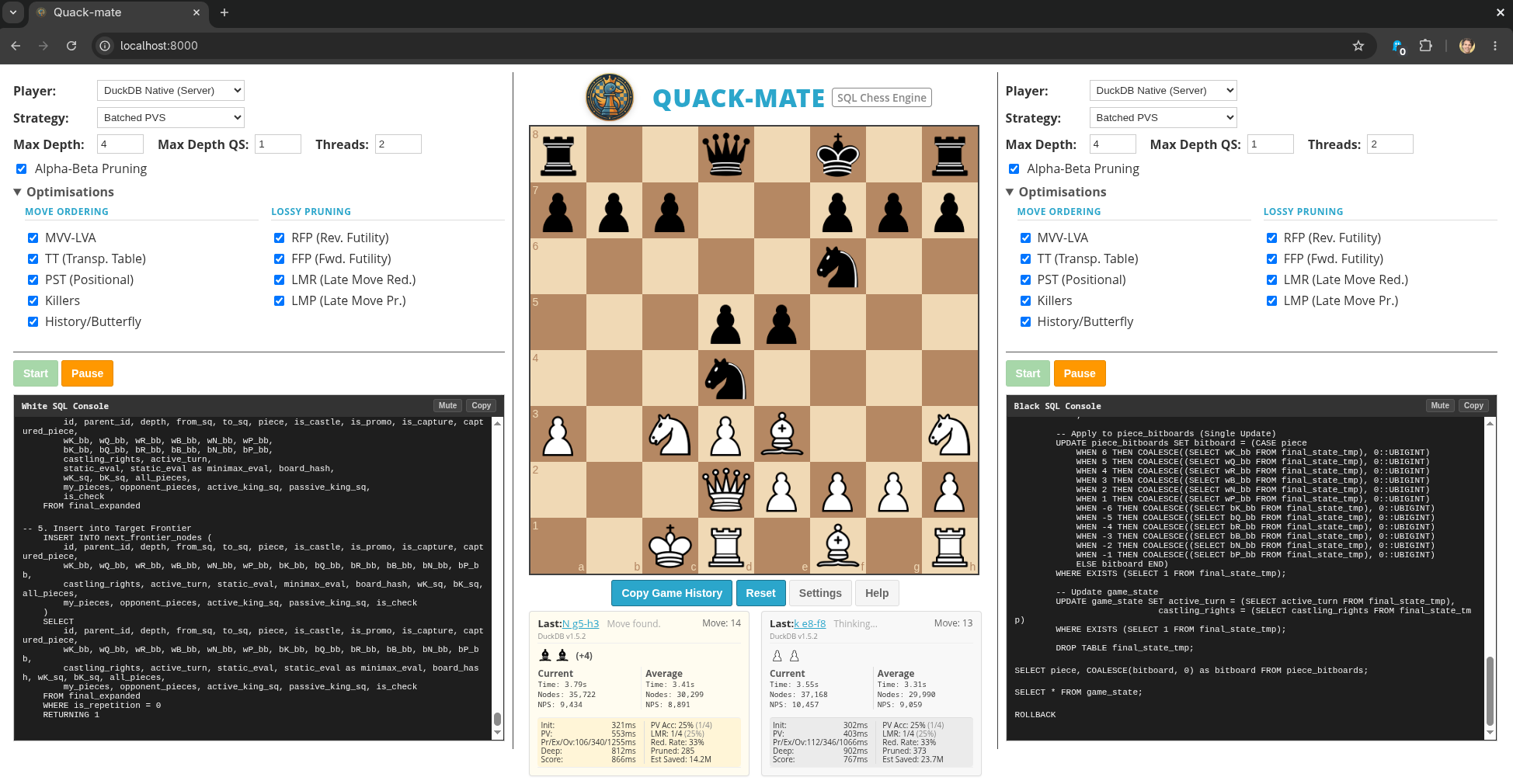
Here is the Quack-Mate user interface in action. You can play the WebAssembly (WASM) version online in your browser (not from your phone, sorry), or run the interface locally using the native Node.js DuckDB driver for a significant performance boost. As the engine thinks, the interface exposes the exact SQL queries executing under the hood in real-time, alongside checkboxes to toggle specific move ordering or lossy pruning heuristics and a complete breakdown of detailed search statistics:
 Play Quack-Mate Online
If you have played a few games and explored the source code, you might wonder why anyone would choose to build a chess engine this way. For me, it began with a simple realisation: it seemed nobody had done it before—at least, not like this. While there have been a few attempts to implement chess in databases, they typically rely heavily on procedural extensions like Oracle’s PL/SQL or PostgreSQL’s PL/pgSQL (with explicit loops and variables), or they are written as C extensions. Implementing a fully functioning chess engine purely through relational algebra and standard SQL queries on a modern analytical engine (like the brilliant DuckDB) felt like uncharted territory.
Modern analytical engines like DuckDB are absolute beasts at crunching numbers in high volumes. Exploring the immense tree of chess possibilities immediately brings to mind joining a table of ‘boards’ with a table of ‘all possible moves’ to create a new generation of boards. If a pure SQL formulation is possible, you get the tremendous benefits of advanced database engines for free: brutal query optimisation and vectorised parallelisation over millions of rows.
But why is raw efficiency so heavily emphasised in chess programming? It comes down to a computational challenge known as combinatorial explosion. From the starting position, White has 20 possible moves, and Black has 20 responses, meaning there are 400 possible games after just one full turn. After three full turns, there are over 119 million possible games. After just four full turns (8 plies), the game tree explodes to roughly 85 billion possible games! To play well, an engine must look as far ahead into these exponentially growing branches as possible. Therefore, in chess engines, speed directly translates to search depth, and depth translates directly into playing strength.
Anatomy of a Chess Engine (and How SQL Handles It)
Before diving into the complex queries, it helps to understand the basic components of a traditional chess engine and how Quack-Mate translates them into the language of relational databases.
Board Representation & Bitboards
The absolute foundation of any engine is how it “sees” the game. A highly optimised state representation is critical because the engine will need to store, copy, and evaluate millions of these states per second during a deep search.
Before we talk about moving pieces, we have to talk about how the board is stored. A chess board has 64 squares. By a happy coincidence of computing history, modern CPU registers are standardly 64 bits wide.
Modern chess engines use Bitboards: 64-bit integers where each bit represents a square on the board (1 if occupied, 0 if empty). Instead of keeping one big array that says “Square E4 houses a White Pawn”, engines maintain separate bitboards for each piece type. You need 12 in total: White Pawns, White Knights, Black Pawns… all the way to Black Kings.
Using Bitboards means answering chess questions becomes highly efficient bitwise math.
All the White Pawns are identified by a specific bitboard:
wP_bb
Where are all the white pieces?
w_bb = wP_bb | wN_bb | ... | wK_bb
Is that square empty?
((w_bb | b_bb) & square_mask) == 0
Want to flip the presence of a White Knight on a specific square?
wN_bb ^ square_mask
This is how modern engines evaluate positions millions of times per second.
To replicate this state-of-the-art representation in a database, we hit an immediate wall. Standard SQL does not have unsigned 64-bit integers.
One option is to use SQL bitstring types (like PostgreSQL’s BIT(64)), which natively allow manipulating 64 bits correctly. However, these are generally much less efficient than native integer types when performing large-scale operations. Alternatively, we could use a standard signed BIGINT (like int8 in PostgreSQL). However, a signed 64-bit integer uses the 64th bit as the sign bit. The primary issue this introduces is with the right-shift operator (>>), which performs an arithmetic shift (propagating the sign bit) instead of a logical shift. Painstakingly using a signed BIGINT is possible, but it requires injecting computationally expensive masking conditions into every query just to isolate and handle the sign bit correctly.
Alternatively, you could reach for larger or non-standard SQL data types, but this solution isn’t optimal either:
- ClickHouse: The leader in this space, offering native 128-bit (
UInt128) and even 256-bit unsigned integers. - MonetDB: Offers a native 128-bit
HUGEINTtype. An early prototype of Quack-Mate actually supported both DuckDB and MonetDB (using theHUGEINTtype), as they both are high-performance analytical engines. - Snowflake: Its primary numeric type is
NUMBER, but its internal engine and bitwise functions (likeBITAND,BITSHIFTLEFT) actually operate on and return signed 128-bit integers. - PostgreSQL (via Extension): While lacking native support in core, the specialised
pg-uint128extension adds unsigned 128-bit integers (which can introduce query execution overhead when processing operations over non-native extension types).
This is precisely where DuckDB shines. I eventually focussed on it because it hits the exact sweet spot: it provides native UBIGINT support to avoid 128-bit overhead, while its high-performance analytical engine allows us to process massive game trees entirely in-process. While a few other databases also support unsigned 64-bit integers (such as MySQL, MariaDB, and ClickHouse), DuckDB’s unique architecture provides the perfect environment for a SQL-based engine to prove its worth.
By storing the entire game state as a single database row containing 12 UBIGINT columns, we can finally translate chess computations into pure, vectorised SQL operations. The mechanical efficiency of bitboards is most striking when moving a piece down the search tree. Instead of looping over a traditional array to painstakingly clear “Square A1” and write to “Square A2”, a move mathematically distils down to two simple square-presence flips. By applying two bitwise XOR operations against the original bitboard—one to toggle off the “from” square, and one to toggle on the “to” square—the piece instantly teleports to its new destination.
In short: board ^= (square_from | square_to):
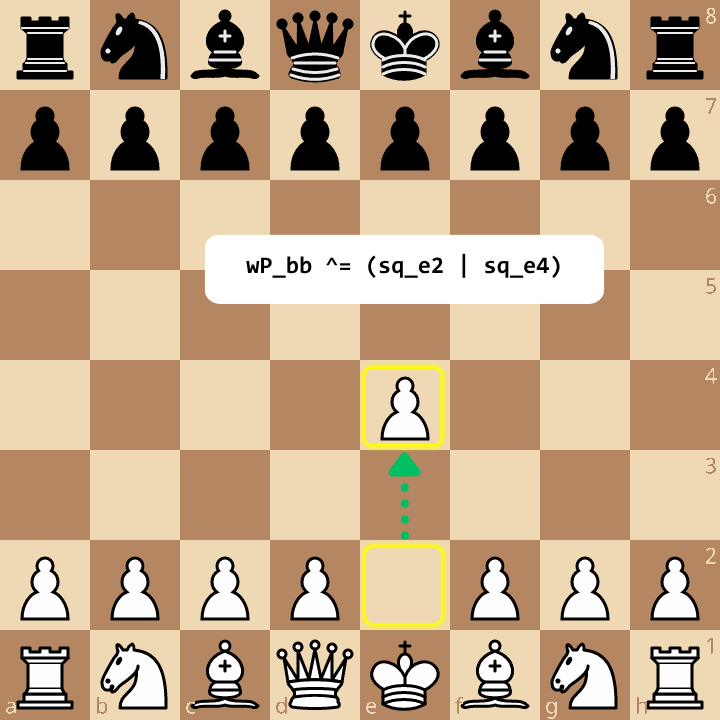
Because DuckDB supports these bitwise operators natively on unsigned integers, the analytical engine can execute these binary flips across millions of rows simultaneously:
-- Applying a move to the white pawns bitboard
SELECT
    -- XORing the combined (OR'd) masks toggles both squares at once
    xor(s.wP_bb, (deltaFrom_mask | deltaTo_mask)) AS wP_bb
FROM current_states s
-- (This happens concurrently for all 12 piece column types)
Pseudo-Move Generation
To look into the future, the engine must systematically generate all possible next moves from a given position. Building the massive tree of variations starts here. These generated moves are “pseudo-legal”. This means they follow the basic geometric movement rules of the pieces (e.g., a bishop moving diagonally), but they don’t yet account for complex board state rules, like whether making that move would illegally expose the player’s own King to check.
The Imperative Approach
While modern engines don’t naively loop over all 64 squares, they do iterate piece-by-piece.
🛠️ Click to expand technical details
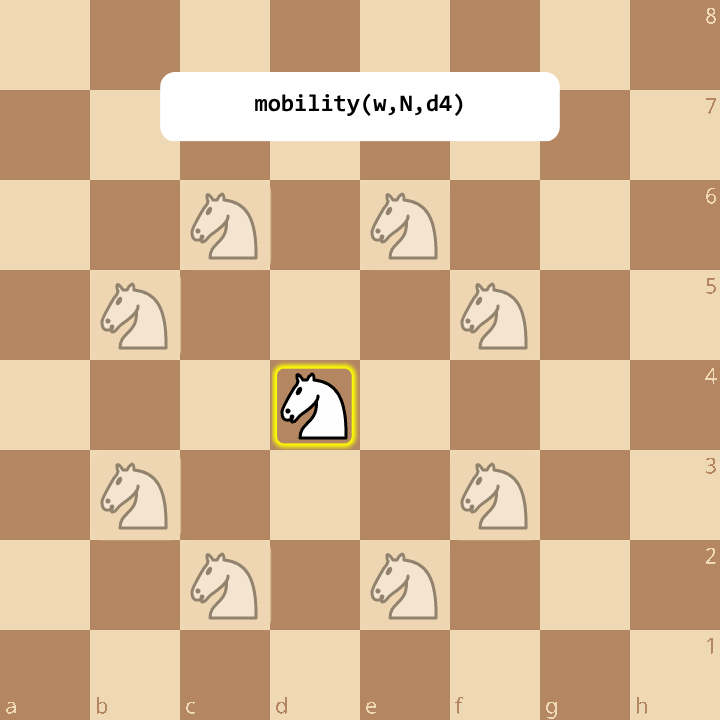
They grab the bitboard for a specific piece type (like Knights), use hardware instructions to find the first set bit (the square the piece is on), and then loop over its pre-calculated “mobility mask”—a bitboard showing every legally reachable square from that position regardless of whether an enemy piece is there or not—to generate moves.
// Generating pseudo-legal moves (imperative bitboard engine)
U64 knights = board.white_knights_bb;

// Loop over every knight we have
while (knights) {
    // Hardware instruction finds the piece's square index
    int sq = pop_lsb(&knights);

    // Look up the mobility mask and loop over every reachable target square
    U64 valid_destinations = KNIGHT_MOBILITY[sq] & ~board.own_pieces_bb;
    while (valid_destinations) {
        int target_sq = pop_lsb(&valid_destinations);
        add_move(move_list, sq, target_sq);
    }
}
// ... repeat this entire process for Bishops, Rooks, Queens, etc.
The Relational Approach
Generating next moves isn’t done piece-by-piece; it’s a massive, concurrent JOIN operation. Quack-Mate supports all standard legal chess moves—including castling and pawn promotions—with the sole exception of the en-passant rule. While essential for full FIDE compliance, tracking the transient history-dependent state required for en-passant in pure SQL adds substantial query and schema complexity to the move generator. To keep the relational joins and database schema as clean and streamlined as possible, en-passant is currently omitted from the move generator.
🛠️ Click to expand technical details
We pre-compute these masks for every piece on every square and store them as two static lookup tables: mobility_precomputed (showing where a piece can legally move) and attacks_precomputed (a separate table necessary specifically for Pawns, which move forward but capture diagonally). We explode the current game state out into all its pieces and join them with the pre-computed mobility tables to instantly spawn rows for every possible pseudo-legal continuation for all pieces simultaneously.
The JOIN LATERAL pattern acts as our primary move generator. It iterates over a 64-row squares table, using a nested CASE WHEN to check the active turn at the top level. This allows DuckDB to instantly short-circuit and skip checking the inactive player’s bitboards entirely. Active piece squares are identified and directly joined to mobility_precomputed on unsigned piece equality (mp.piece = pt.piece) to leverage static indices, while empty squares are filtered instantly at the join boundary via pt.piece IS NOT NULL.
SELECT
    s.id AS parent_id, sq.i AS from_sq, m.target_sq AS to_sq,
    (pt.piece * s.active_turn)::TINYINT AS piece
FROM squares sq
-- CROSS JOIN s -- (when bulk processing)

-- 1. Explode: Find occupied squares and identify pieces using a nested turn check
JOIN LATERAL (
    SELECT (CASE WHEN s.active_turn = 1 THEN
        (CASE
            WHEN is_bit_set(s.wN_bb, sq.i) THEN 2
            WHEN is_bit_set(s.wB_bb, sq.i) THEN 3
            WHEN is_bit_set(s.wR_bb, sq.i) THEN 4
            WHEN is_bit_set(s.wQ_bb, sq.i) THEN 5
            WHEN is_bit_set(s.wK_bb, sq.i) THEN 6
        END)
    ELSE
        (CASE
            WHEN is_bit_set(s.bN_bb, sq.i) THEN 2
            WHEN is_bit_set(s.bB_bb, sq.i) THEN 3
            WHEN is_bit_set(s.bR_bb, sq.i) THEN 4
            WHEN is_bit_set(s.bQ_bb, sq.i) THEN 5
            WHEN is_bit_set(s.bK_bb, sq.i) THEN 6
        END)
    END) AS piece
) pt ON pt.piece IS NOT NULL

-- 2. Join Mobility
JOIN mobility_precomputed m ON m.from_sq = sq.i AND m.piece = pt.piece
WHERE (m.ray_mask & s.all_pieces_bb) = 0
  AND NOT is_bit_set(s.my_pieces_bb, m.target_sq)

UNION ALL

-- 3. Generate pawn captures separately using attack masks
SELECT
    s.id AS parent_id, sq.i AS from_sq, a.target_sq AS to_sq, 1 AS piece
FROM current_states s
JOIN LATERAL (SELECT 1 AS piece WHERE is_bit_set(s.wP_bb, sq.i)) p ON true
JOIN attacks_precomputed a ON a.from_sq = sq.i AND a.piece = p.piece
-- Pawn attacks are only valid legal moves if an opponent piece is actually there to capture!
WHERE is_bit_set(s.opponent_pieces_bb, a.target_sq)
Is the King in Check? (Move Validation)
Chess rules forbid making a move that leaves your own King under attack. “Pseudo-move generation” creates moves based on piece logic, but “validation” acts as the strict filter that tosses out the illegal ones before they pollute the search tree.
Checking legality normally requires calculating complex “pin masks”. SQL is terrible at this. To bypass it, we reverse the math: instead of tracking protecting pieces, we check if our King could theoretically attack the enemy piece in return.
The Imperative Approach
Modern engines use fast bitwise math on the current board state to check legality, rather than making and un-making moves.
🛠️ Click to expand technical details
While older or simpler engines might literally “make the move, check if the king is attacked, take it back,” this is way too slow for a modern engine. Modern engines pre-calculate an “absolute pin mask” for pieces defending the king and evaluate if a proposed move violates a pin or places the King onto an attacked square, usually doing this validation lazily right before the move is searched.
// Fast bitwise legality test on the current state (modern imperative)
bool is_legal(Board board, Move move) {
    if (piece_type(move) == KING) {
        return !is_square_attacked(board, to_sq(move), opponent);
    }
    // If piece is pinned, it can only move along the pinning ray.
    // (A jumping Knight's move will never align, cleanly returning false).
    if ((board.pinned_mask & (1ULL << from_sq(move)))) {
        return aligned(from_sq(move), to_sq(move), board.king_sq);
    }
    // ... en-passant edge cases
    return true;
}
The Relational Approach
Quack-Mate embraces the brute force of set theory by applying all moves simultaneously and then filtering the illegal ones via a “backwards” attack check.
🛠️ Click to expand technical details
Calculating absolute pin masks dynamically in pure SQL is incredibly inefficient. Instead, Quack-Mate skips pre-validation: we apply all pseudo-legal moves in bulk to spawn a CTE of expanded_states, then filter the illegal boards.
While classical engines maintain a single board state and sequentially “make” and “un-make” moves in a loop to conserve memory, SQL excels at generating massive sets of independent, immutable rows simultaneously.
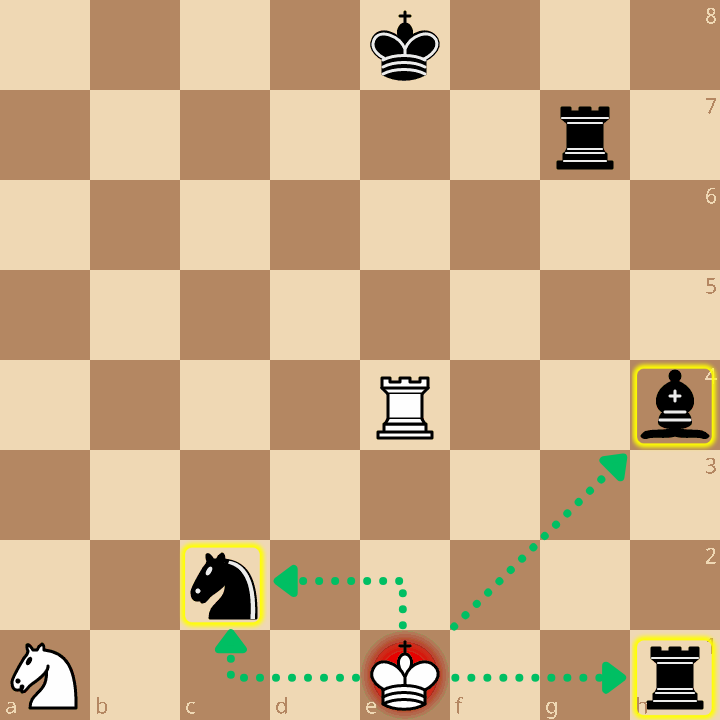
To filter out the illegal states without complex pin-masks, we check legality concurrently using a “backwards” attack check: we trace attacks in reverse starting from the King’s square. By executing an EXISTS subquery that bitwise ANDs precomputed attack masks against the unexploded enemy bitboards, we compress a massive, multi-row O(N) piece-explosion per state into a fast O(1) lookup.
SELECT * FROM expanded_states m
-- Filter out the rows where the King is left under attack
WHERE NOT EXISTS (
    SELECT 1 FROM attacks_precomputed ap
    WHERE ap.square = m.king_sq
    AND (
        -- If we conceptually place a Knight on the King's square, does it hit an enemy Knight?
        (m.enemy_knights_bb & ap.knight_mask) <> 0 OR
        -- ... does it hit an enemy pawn? ... etc
        (m.enemy_pawns_bb & ap.pawn_mask) <> 0
    )
    -- (A similar subquery checks sliding pieces through mobility_precomputed)
)
Board Evaluation
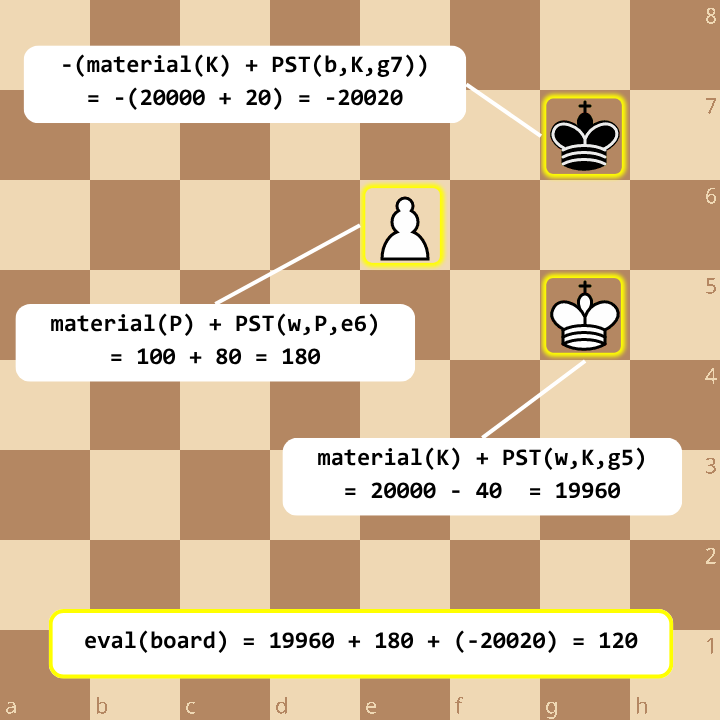
Once the engine reaches its maximum search depth, it has to stop looking ahead and simply judge the resulting position. This “static evaluation” provides the heuristic score that tells the engine whether the sequence of moves that led to the current board was brilliant or disastrous. To do this, Quack-Mate utilises material values (the static value assigned to each piece type) and Tomasz Michniewski’s Simplified Evaluation Function, a famous set of Piece-Square Tables (PST) designed to give an engine basic positional understanding (like centralising knights and castling the king) without requiring complex heuristic logic. A simple sum of all material and PST values (positive for white, negative for black) determines the total board value.
The Imperative Approach
Historically, static evaluation functions looped over an array representation of the board, summing up the material and PST values corresponding to the piece at each square.
🛠️ Click to expand technical details
An imperative bitboard engine provides a massive constant-factor speedup by using hardware popcount instructions (which instantly count how many bits are set to 1) to sum up material, and pop_lsb loops to apply Piece-Square Table (PST) bonuses for positional placement. Modern world-champion engines like Stockfish, however, go infinitely further: they evaluate complex heuristics like pawn structures and king safety, and increasingly rely on efficiently updatable neural networks (NNUE) to score the board state holistically.
// A classic bitboard evaluation function
int score = 0;

// Hardware popcount calculates material sums instantly without looping
score += popcount(board.white_queens) * 5;
score -= popcount(board.black_queens) * 5;
score += popcount(board.white_knights) * 2;
score -= popcount(board.black_knights) * 2;
// ... (repeat for all piece types)

// piece-square tables are tabulated by popping bits
U64 white_knights = board.white_knights;
while (white_knights) {
    int sq = pop_lsb(&white_knights);
    score += PST_KNIGHT[sq];
}
// ... (repeat popping loop for black knights, queens, etc.)

// Modern engines eschew all of this for NNUE inferences:
// return evaluate_nnue(board);
return score;
The Relational Approach
Quack-Mate’s evaluation is purely mathematical and set-based, leveraging DuckDB’s ability to process massive board sets simultaneously.
🛠️ Click to expand technical details
Integrating a neural network or complex pawn-structure algorithms into a single recursive SQL query is practically impossible without crushing performance. Therefore, Quack-Mate’s evaluation remains set-based (the classic Material + PST approach). The SQL engine accomplishes this via a correlated subquery: for each board row, it pivots the 12 bitboard columns into 12 distinct rows on the fly using a VALUES table. The engine then performs a single set-based JOIN of this massive intermediate set against the pre-computed Piece-Square Table, summing up both the material weight and positional bonuses.
SELECT
    id,
    -- We pivot the columns into rows, and join against the Piece-Square Table
    -- to sum up material and positional bonuses in one go!
    COALESCE(
        (SELECT SUM(pst.value)
        FROM pst_values pst,
        (VALUES
            (5, wQ_bb), (-5, bQ_bb), -- Queens
            (2, wN_bb), (-2, bN_bb)  -- Knights (etc...)
        ) AS pb(piece, bitboard)
        WHERE pst.piece = pb.piece
        AND is_bit_set(pb.bitboard, pst.square))
    , 0) AS static_eval
FROM search_tree
WHERE depth = MAX_DEPTH
Database Notes
-
Referencing outer query columns like
wQ_bbdirectly inside aVALUEStable constructor is historically restricted in many SQL dialects unless explicitly wrapped in aLATERALjoin. DuckDB’s parser natively supports this correlated variable injection, saving us from writing a much clunkier subquery. -
While this is a beautiful example of purely relational set-math, executing it dynamically at every single leaf node is computationally heavy. Quack-Mate optimises this by calculating the PST incrementally. As a piece moves down the search tree, we calculate the delta (subtracting the piece’s value on the source square and adding its value on the destination square). The static evaluation at the leaf node simply reads this continuously updated, running total.
The Elegance of the Single Query: Recursive Minimax
The engine has now generated the tree of legal moves and statically evaluated the final resulting board states (the leaf nodes). To make a decision, these scores must bubble back up to the root node so the engine can select the optimal move, assuming best play from both sides.
In an imperative language, a minimax function recursively calls itself. In SQL, we can express this entire cycle of generation, evaluation, and score propagation within a single query using a WITH RECURSIVE Common Table Expression (CTE).
The Imperative Approach
In an imperative language, a minimax function calls itself recursively to explore the game tree.
Every level in this tree represents a “ply” (a single half-move by either White or Black). At each ply, the algorithm swaps sides and assumes that the player whose turn it is will play perfectly to maximise their own advantage. When the search hits the maximum depth limit, it evaluates the board and recursively bubbles those static scores back up.
int minimax(Board node, int depth, bool is_white_turn) {
    // EVALUATION (base case)
    if (depth == MAX_DEPTH) {
        return static_eval(node);
    }

    // EXPANSION
    MoveList children = generate_moves(node);

    // BACKPROPAGATION & The "Mini-Max" Logic
    int best_score = is_white_turn ? -INFINITY : INFINITY;

    for (Move child : children) {
        // Recursively visit children
        int score = minimax(child.board, depth + 1, !is_white_turn);

        if (is_white_turn) {
            best_score = max(best_score, score); // White maximises
        } else {
            best_score = min(best_score, score); // Black minimises
        }
    }

    return best_score;
}
The Relational Approach
We can represent this exact same algorithm relationally. Instead of a sequential call stack, we execute a single, elegant SQL query that preserves the exact same two-phase structure as the C++ code: a top-down expansion of the search space, followed by a bottom-up backpropagation of the minimax scores.
By mapping the recursive expansion to one CTE and the bottom-up minimax aggregation to another (leveraging GROUP BY parent_id and side-specific MIN/MAX aggregates), the database engine handles the entire tree traversal natively in a single, set-based transaction.
WITH RECURSIVE
    -- Expansion CTE: Top-down
    search_tree AS (
        -- Expansion base case: Root Node
        SELECT id, state, 0 as depth, is_white_turn FROM root

        UNION ALL

        -- Expansion step
        SELECT child.id, child.state, parent.depth + 1, child.is_white_turn
        FROM search_tree parent
        JOIN possible_moves child ON ...
        WHERE parent.depth < MAX_DEPTH
    ),

    -- Minimax CTE: Bottom-up
    minimax AS (
        -- Back-propagation base case:
        -- Target depth or terminal nodes
        SELECT id, parent_id, depth, static_eval(state) as score, 0 as step
        FROM search_tree s
        WHERE s.depth = MAX_DEPTH
           OR NOT EXISTS (SELECT 1 FROM search_tree child WHERE child.parent_id = s.id)

        UNION ALL

        -- Back-propagation step
        SELECT
            parent.id, parent.parent_id, parent.depth,
            CASE WHEN parent.is_white_turn
                 THEN MAX(child.score) -- White maximises
                 ELSE MIN(child.score) -- Black minimises
            END as score,
            prev.step + 1 as step
        FROM (SELECT DISTINCT step FROM minimax) prev
        JOIN search_tree parent ON parent.depth = MAX_DEPTH - (prev.step + 1)
        JOIN recurring.minimax child ON child.parent_id = parent.id
        GROUP BY parent.id, parent.parent_id, parent.depth, parent.is_white_turn, prev.step
    )
SELECT score FROM minimax WHERE depth = 0;
💡 Have you noticed the recurring.minimax syntax?
Under standard ANSI SQL recursive CTE rules, the recursive member only has access to the rows produced in the immediately preceding step (known as semi-naive evaluation).
In game trees, this creates a major mixed-depth synchronization hurdle: if some lines terminate early (such as checkmate at depth 2 while other lines run to depth 4), standard ANSI CTEs evaluate the parent nodes partially across disjoint steps, leading to duplicated and corrupted minimax scores at the root.
However, starting with DuckDB >= 1.5, a new feature has been introduced to solve this (thanks to Denis Hirn for the tip!): by referencing the recursive table as recurring.<recursive_cte>, DuckDB enables all-rows recursive semantics. This grants the recursive step access to all rows produced across all previous steps so far.
In Quack-Mate, we leverage this in production using a depth-stepping join to evaluate parent nodes strictly ply-by-ply:
FROM (SELECT DISTINCT step FROM minimax) prev
JOIN search_tree parent ON parent.depth = MAX_DEPTH - (prev.step + 1)
JOIN recurring.minimax child ON child.parent_id = parent.id
By selecting the step number from the standard, non-recurring minimax table, the CTE increments exactly one ply per iteration. We then join parents whose depth matches MAX_DEPTH - (prev.step + 1) against the recurring.minimax child table containing all previously evaluated nodes. This keeps the minimax aggregation synchronized in a single recursive query.
⚠️ Compatibility Note: If you are working on a database engine that does not support the recurring. syntax, the only way to achieve correct mixed-depth score synchronization is to programmatically unroll the backpropagation sequence in your application code (e.g., in JavaScript) into separate, explicitly chained per-ply CTEs (e.g., minimax_d3, minimax_d2, etc.). This ensures that all prior plies remain accessible to parents at the cost of losing some of the recursion elegance.
The Hard Limits of Elegance
This recursive CTE approach is incredibly neat, but its limitations become apparent rather quickly. It successfully calculates the best move, but it has to analyse every single possible move to do so. This is known as an un-pruned search.
To search deep enough to play well, engines rely on Alpha-Beta Pruning. Conceptually, Alpha-Beta pruning is a mathematical shortcut: if you are evaluating a sequence of moves and you discover a single opponent response that completely refutes your idea (e.g., you lose your Queen for nothing), you can immediately stop searching that branch. You don’t need to know exactly how badly you lose if you play it; you just need to know it’s worse than an alternative you already found.
For Alpha-Beta pruning to be effective, it inherently requires a Depth-First Search (DFS). The engine must plunge down a single, promising branch all the way to the end to establish a strong “score to beat.” This threshold is tracked using two mathematical bounds: Alpha (the minimum guaranteed score for the current player) and Beta (the maximum score the opponent will ever allow you to achieve).
The diagram below visualises this process on a toy-sized search tree. Follow the sequential numbers ([1], [2], [3], etc.) to trace the engine’s exact Depth-First execution path. Because the engine plunges all the way down the left-most branch first, it establishes a high Alpha bound early. By the time it evaluates the alternative move on the right, Black immediately finds a devastating response, driving Beta below Alpha. The engine instantly cuts off the search, completely bypassing the remaining unexplored sub-tree.
%%{init: {"flowchart": {"nodeSpacing": 20, "rankSpacing": 40}, "themeVariables": {"fontSize": "20px"}}}%%
graph TD
    %% Styling definitions
    classDef maxNode fill:#f1f2f6,stroke:#2f3542,stroke-width:3px,color:#2f3542,font-weight:bold;
    classDef minNode fill:#2f3542,stroke:#f1f2f6,stroke-width:3px,color:#f1f2f6,font-weight:bold;
    classDef leafNode fill:#1e90ff,stroke:#3742fa,stroke-width:2px,color:#ffffff,font-weight:bold;
    classDef prunedNode fill:#ff4757,stroke:#ff6b81,stroke-width:2px,color:#ffffff,stroke-dasharray: 5 5,font-weight:bold;

    Root("[1] White (MAX)
α=4, β=∞"):::maxNode

    NodeA("[2] Black (MIN)
α=-∞, β=4"):::minNode
    NodeB("[9] Black (MIN)
α=4, β=3"):::minNode

    NodeC("[3] White (MAX)
Returns: +4"):::maxNode
    NodeD("[6] White (MAX)
Returns: +6"):::maxNode

    NodeE("[10] White (MAX)
Returns: +3"):::maxNode
    NodeF("[X] White (MAX)
Pruned Sub-tree"):::prunedNode

    Leaf1("[4] Eval: +4"):::leafNode
    Leaf2("[5] Eval: +3"):::leafNode
    Leaf3("[7] Eval: +5"):::leafNode
    Leaf4("[8] Eval: +6"):::leafNode

    Leaf5("[11] Eval: +3"):::leafNode
    Leaf6("[12] Eval: +2"):::leafNode
    Leaf7("[X] Eval: ??"):::prunedNode
    Leaf8("[X] Eval: ??"):::prunedNode

    Root -->|First Candidate Move| NodeA
    Root -->|Alternative Move| NodeB

    NodeA --> NodeC
    NodeA --> NodeD

    NodeB --> NodeE
    NodeB -.->|Cutoff: β <= α| NodeF

    NodeC --> Leaf1
    NodeC --> Leaf2

    NodeD --> Leaf3
    NodeD --> Leaf4

    NodeE --> Leaf5
    NodeE --> Leaf6

    NodeF -.-> Leaf7
    NodeF -.-> Leaf8
💡 Click to expand a more intuitive explanation of alpha-beta pruning
To understand this more intuitively, imagine you are shopping for a new house with a very picky partner:
- Alpha (Your “Floor”): You’ve already found a nice house, House A, with a value score of €200,000. This is your “best found so far” that you are guaranteed to accept. You will never accept anything worse than this.
- Beta (Your Partner’s “Ceiling”): Your partner (acting as the minimising opponent) wants to limit spending and has set a strict cap: “I will never agree to a house that costs or is valued over €250,000.” This is the ceiling they will allow you to reach.
Now you visit House B. As soon as you see it’s a massive estate valued at €300,000, you walk out. You don’t need to check the kitchen or the backyard—you already know your partner will veto it to stay under their €250,000 ceiling. This is an Alpha-Beta Cutoff.
In the engine’s search tree, we classify these moments as:
- Fail-Low (score ≤ Alpha): You find a house valued at €150,000 that is a total wreck. It’s below your €200,000 floor. You ignore it and keep looking.
- Fail-High (score ≥ Beta): You find a luxurious mansion valued at €300,000. It’s “too good” (exceeds your partner’s €250,000 ceiling). Since your partner will never allow the transaction to reach this state, you stop searching this branch immediately.
Establishment of these bounds is what allows an engine to ignore 99% of the game tree. Once they are established, the engine can use them to rapidly prune the remaining, shallower branches.
This is exactly where the single-query SQL approach fails. A WITH RECURSIVE query is inherently a Breadth-First Search (BFS) engine. It generates all moves at depth 1, then all responses at depth 2 simultaneously. It cannot plunge down a single path to establish a pruning threshold before looking at the others. Because the engine must hold every single position of every single depth in memory simultaneously, a search depth of merely 3 logical turns becomes a hard limit. Going any deeper means waiting an eternity and watching your RAM vanish into the ether.
Furthermore, integrating a sequential, threshold-updating logic like Alpha-Beta pruning across parallelised, set-based rows within a single monolithic query is exceptionally difficult to express and execute performantly.
Breaking the Limit: Orchestration and Iterative Deepening
To make the engine actually playable, elegance had to make way for pragmatism. I implemented a strategy called Batched Principal Variation Search (BPVS). That name is quite a mouthful—we will unpack the exact mechanics of “Batched” and “Principal Variation Search” in the following sections, as they rely on advanced pruning concepts.
At its foundation, however, BPVS abandons the single recursive SQL query in favour of a lightweight, external Javascript loop acting as an orchestrator. This orchestrator contains no chess logic; its sole responsibility is to track the search state and execute a standard chess technique called Iterative Deepening.
Instead of telling DuckDB to search directly to Depth N, the Javascript orchestrator runs a series of discrete searches: Depth 1, then restarting from the root to reach Depth 2, then restarting again for Depth 3, and so on. This might sound wasteful—why throw away the tree and start over?—but it solves two massive problems:
- Memory Efficiency: A single recursive CTE query is an atomic operation that must hold every intermediate step in memory simultaneously. By breaking the search into discrete transactions, we can physically
DELETEworking tables between iterations, forcing DuckDB to clear its RAM. More importantly, it enables Move Ordering (searching the best moves first to trigger early Alpha-Beta cutoffs), meaning the final iteration’s search tree is heavily pruned and exponentially smaller. - Query Bounds: The database engine cannot dynamically update Alpha-Beta pruning thresholds mid-query. By orchestrating a controlled sequence of discrete SQL queries (
expand,evaluate, andbubble_up), the Javascript puppet master can “pause” between database executions, read the resulting bounds, and dynamically inject them into the next SQL string.
But why restart from Depth 0, duplicating the work of previous iterations, instead of saving the Depth 2 tree and simply expanding its leaves?
Doing so destroys Alpha-Beta pruning! To get a strong pruning threshold (Alpha) early, the engine must trace the single most promising path (the Principal Variation) down to the target depth, evaluate it, and bubble that score back up. Only armed with this updated global bound can the engine safely prune terrible branches at shallow levels. Because the chess tree grows exponentially, the cost of regenerating shallow nodes is mathematically negligible (typically under 3% of the total search time) compared to the staggering savings from entering each new iteration already knowing which moves proved strongest in the previous one.
The Pruning Prerequisite: Move Ordering
If an engine happens to search the best moves first, it can mathematically prove that certain other branches don’t need to be searched at all (this is Alpha-Beta pruning). Guessing which moves will be the best before actually searching them is the secret to a fast engine, and the cornerstone of our BPVS approach.
It is crucial to distinguish Move Ordering Scores from the Static Evaluation discussed previously. Static Evaluation is a deep, mathematically rigorous judgement of the final board state at the very end of a search branch. Move Ordering is a “quick and dirty” heuristic applied before searching. Its sole job is to guess which moves are the most promising so the engine can search them first.
The Imperative Approach
Before diving down into the search tree, engines generate a list of legal moves and assign each a quick ordering_score.
🛠️ Click to expand technical details
While this score can sometimes incorporate the current static evaluation as a baseline, it relies heavily on move-specific heuristics, such as prioritising moves that capture a high-value piece using a low-value piece (MVV-LVA). A modern engine combines several of these heuristics to calculate a move’s score, then sorts the move array.
// Score moves before searching them to maximise Alpha-Beta pruning
for (int i = 0; i < move_count; i++) {
    int ordering_score = 0;
    Move m = moves[i];

    if (is_capture(m)) {
        // MVV-LVA: Most Valuable Victim - Least Valuable Attacker
        // E.g., Pawn taking a Queen gets a massive ordering score
        ordering_score = (10 * piece_value[captured_piece(m)]) - piece_value[moving_piece(m)];
    } else if (is_killer_move(m)) {
        // Bonus for non-captures that proved strong in sibling branches
        ordering_score = KILLER_BONUS;
    }
    // ... add to static evaluation baseline, etc.

    move_scores[i] = ordering_score;
}
// Search the moves with the highest ordering scores first
sort_moves_by_score(moves, move_scores);
The Relational Approach
In our BPVS approach, move ordering is handled via SQL Window Functions to rank sibling moves.
🛠️ Click to expand technical details
We compute an estimated score for each generated move row based on a strict layering of heuristics: Transposition Table hits, Captures (MVV-LVA), Checks, and Killer Moves. Finally, as a fallback for “quiet moves,” we use History scores. We use ROW_NUMBER() partitioned by the parent board state to rank these sibling moves. Our pipeline then processes the most promising moves first in a “Principal Variation” batch, aggressively establishing a high Alpha threshold to prune the subsequent batches.
SELECT *,
    ROW_NUMBER() OVER (
        PARTITION BY parent_id
        ORDER BY (
            -- 1. TT Best Move: > 2,000,000
            (CASE WHEN is_tt_hit = 1 THEN 2000000 ELSE 0 END) +
            -- 2. Captures (MVV-LVA): > 1,000,000
            (CASE WHEN is_capture = 1 THEN 1000000 + (piece_val(captured) * 10 - piece_val(attacker)) ELSE 0 END) +
            -- 3. Checks: > 600,000
            (CASE WHEN is_check = 1 THEN 600000 ELSE 0 END) +
            -- 4. Killers: > 500,000
            (CASE WHEN is_killer = 1 THEN 500000 ELSE 0 END) +
            -- 5. History + Positional (PST): < 400,000
            COALESCE(history_score, 0) + COALESCE(pst_value, 0)
        ) DESC
    ) as rank
FROM candidate_moves
Let’s take a deep dive into the specific techniques integrated to squeeze every drop of performance out of the engine, and how the conceptual leap from arrays to tables is made.
Principal Variation Search (PVS) & Alpha-Beta Pruning
While standard Alpha-Beta pruning is the mathematical foundation of modern chess engines, Quack-Mate skips implementing it directly and instead relies exclusively on a more advanced variant called Principal Variation Search (PVS). As we will see later, this is not just an optimisation, but a structural necessity for the database architecture. The core premise of PVS is that if our move ordering is good, the very first move we examine (the Principal Variation, or PV) is highly likely to be the best.
The Imperative Approach
The PVS algorithm searches this first expected “best move” with a standard, wide “full window” (passing the actual, broad Alpha and Beta bounds) to figure out exactly how good it is.
🛠️ Click to expand technical details
The engine assumes that sibling moves are worse than the PV. We can prove this quickly by searching them with a “zero window” (where alpha and beta are identical). A zero-window search is incredibly fast because almost every branch is instantly pruned. If it somehow proves it’s better, we must re-search that move with a full window to find its true score.
int pvs(Board node, int ply, int limit, int alpha, int beta) {
    if (ply == limit) {
        int color_multiplier = is_white_turn(node) ? 1 : -1;
        return static_eval(node) * color_multiplier;
    }
    bool is_first_move = true;
    for (Move m : generate_moves(node)) {
        Board next = apply_move(node, m);
        int score;

        if (is_first_move) {
            // Full-window search for the expected best move
            score = -pvs(next, ply + 1, limit, -beta, -alpha);
            is_first_move = false;
        } else {
            // Zero-window search for the rest, expecting them to fail
            score = -pvs(next, ply + 1, limit, -alpha - 1, -alpha);

            // If it failed high, we guessed wrong. Re-search with full window!
            if (score > alpha && score < beta) {
                score = -pvs(next, ply + 1, limit, -beta, -alpha);
            }
        }
        if (score >= beta) return beta;   // Pruning Cut-Off!
        if (score > alpha) alpha = score; // Update best score
    }
    return alpha;
}
The Relational Approach
This is where the “Batched” in BPVS comes in to save the day. In a traditional engine, you search moves sequentially, one by one. In SQL, searching 30 moves sequentially means 30 round-trips to the database, which is cripplingly slow. However, if you shove all 30 remaining moves into a single SQL query, you cannot update your Alpha-Beta thresholds between them, rendering your pruning useless. We need a compromise.
🛠️ Click to expand technical details
We split the search into two distinct phases:
- The Principal Variation (PV): We search only the single most promising move (
rank = 1) representing the best-guess path for every parent. We search this relatively tiny set of moves at full depth with a full-window to quickly establish strongalphaandbetathresholds. - The Rest: We search all remaining alternate moves. To make this efficient in SQL without losing pruning granularity, we chunk these moves into horizontally sliced Batches.
Choosing the right Batch Size for these alternate moves is a balancing act. A large batch leverages DuckDB’s bulk processing power, but a small batch lets the orchestrator “pause” more often to update pruning thresholds (meaning we can skip bad moves sooner).
To get the best of both worlds, Quack-Mate uses Progressive Batching, mapped exactly to our move-ordering heuristics:
- Batch 0: 1 move (The single best PV or Hash move)
- Batch 1: 3 moves (High-priority tactical strikes like captures and Killer Moves)
- Batch 2: 8 moves (The best remaining positional “quiet” moves)
If the engine hasn’t found an alpha-beta cutoff by move 12, the move ordering has likely failed, or we are at a node where we are forced to search everything anyway. This is where we stop trickling and open the floodgates:
- Batch 3+: All remaining moves chunked into sizes of 64.
In a PVS search, we assume all sibling moves in a batch are worse than our current best. To prove this quickly, we search them at a reduced depth with a “zero-window”. If a move’s score surprisingly exceeds our Alpha threshold, it has “failed high”—proving our assumption was wrong.
When this happens, the Javascript orchestrator discards the shallow results and forces DuckDB to re-search that specific batch at full depth. With Progressive Batching, we evaluate the top moves in tiny batches (1, 3, 8) to get cheap cutoffs with a minimal re-search penalty if we fail high. If no cutoff is found after that, we know we probably have to search the rest anyway. Since an average chess position rarely exceeds 40-50 legal moves, a trailing batch size of 64 guarantees that the database will evaluate 100% of the residual moves in one single, massive query. This perfectly maxes out SQL’s bulk processing efficiency without requiring manual tuning of the batch size option.
This batching introduces a strict “compute overhead” native to SQL. In a standard imperative PVS, if a zero-window search fails high on the second move of a list, the engine instantly aborts the remaining siblings and re-searches that specific move with a full window. In Quack-Mate’s SQL batches, if move #2 of an 8-move batch fails high, DuckDB is already executing the complex relational joins for moves #3 through #8 simultaneously. We fundamentally break the sequential logic of optimal PVS, trading algorithmic efficiency for vectorised throughput.
This creates a hybrid search model: Depth-First in its search strategy (managed by the orchestrator to prioritise the PV), but Breadth-First in its execution model (managed by the database to process batches of moves as sets).
You might be wondering: Could we have just used simple Alpha-Beta mapped to these batches, instead of jumping to a more advanced variant like PVS? We could, but standard Alpha-Beta is fundamentally fluid—the alpha threshold updates continuously as sibling moves are evaluated. If a batch of 8 moves was evaluated simultaneously using standard Alpha-Beta, the 2nd move might improve alpha, meaning the 3rd move should have been instantly pruned. Because SQL evaluates the entire batch at once, we would waste massive compute cycles expanding all subsequent moves before the JavaScript loop could register the new threshold.
This is why PVS is a structural necessity for SQL. By evaluating the remaining sibling moves under the assumption that they will strictly fail against a fixed, identical boundary (the zero-window), PVS creates a perfectly static expectation. This allows DuckDB to aggressively verify thousands of rows in bulk without needing to coordinate threshold updates mid-query.
Move Ordering: Most Valuable Victim - Least Valuable Attacker (MVV-LVA)
The most effective way to trigger early alpha-beta cutoffs is to search the most “violent” moves first. MVV-LVA (Most Valuable Victim - Least Valuable Attacker) is a simple but devastatingly effective heuristic for ordering captures: it prioritises capturing the most valuable enemy pieces using your least valuable ones.
The Imperative Approach
Engines prioritise captures by assigning them a score based on the value of the piece being taken versus the piece doing the attacking.
🛠️ Click to expand technical details
A pawn taking a queen is almost always better than a queen taking a pawn. By searching these high-leverage captures first, the search window narrows rapidly, allowing the engine to prune the rest of the move list much sooner.
if (is_capture(m)) {
    // MVV-LVA heuristic: High victim value, low attacker value
    // E.g., Pawn (1) taking a Queen (9) = (9 * 10) - 1 = 89
    // E.g., Queen (9) taking a Pawn (1) = (1 * 10) - 9 = 1
    ordering_score = (10 * piece_value[captured_piece(m)]) - piece_value[moving_piece(m)];
}
The Relational Approach
In SQL, we calculate the MVV-LVA score for all captures simultaneously using a simple CASE expression within our ordering window function.
🛠️ Click to expand technical details
Because we’ve already identified the piece types during our join-based move generation, calculating the capture priority is a trivial bit of arithmetic that applies instantly across the entire batch of candidate moves.
ORDER BY (
    -- Captures (MVV-LVA): > 1,000,000
    CASE
        WHEN is_capture = 1 THEN 1000000 + (piece_val(captured) * 10 - piece_val(attacker))
        ELSE 0
    END
    -- [..] More move ordering heuristics
) DESC
Move Ordering: Transposition Tables (TT)
In chess, many different sequences of moves can lead to the exact same board position (a transposition). Without memory, an engine will stupidly re-evaluate the same position millions of times. A Transposition Table (TT) solves this by acting as a global cache.
To identify these repeating positions, Quack-Mate (like most modern engines) utilises a Zobrist Hash, a brilliant application of bitwise math. A random, static 64-bit number is pre-generated for every possible piece type appearing on every possible square (yielding an array of 12 piece types × 64 squares = 768 random numbers, plus a handful of extras to track castling rights and turn order). To calculate the hash for any board state, the engine simply takes the random numbers corresponding to the pieces currently on the board, the turn order, and the castling rights, and XORs (^) them all together. Because A ^ A = 0, engines can update this hash incredibly fast incrementally: if a Knight moves from g1 to f3, the engine just takes the old board hash, XORs it by random_White_Knight_g1 to remove the piece, and then XORs by random_White_Knight_f3 to place it.
What gets stored alongside the hash is not just the score, but a measure of how deeply it was computed: the number of plies remaining when the position was evaluated (remaining_depth = MAX_DEPTH - current_depth). A score computed with 3 plies of look-ahead is more reliable than one computed with only 1, so the golden rule of Transposition Tables is: never let a shallower evaluation overwrite a deeper one. With these evaluations securely cached, classical engines read from the TT to perform two distinct roles:
- Total Branch Pruning: If a cached evaluation is found with sufficient depth, the engine instantly returns the score (requiring strict tracking of Alpha/Beta bound types—Exact, Upper, or Lower).
- Move Ordering: If the cached depth is insufficient, the engine extracts the previously saved
best_moveand searches it first, massively increasing the chance of an early Alpha-Beta cutoff.
Where engines diverge is how they store and enforce this rule.
The Imperative Approach
Engines use a fast 64-bit Zobrist Hash as the primary key in a massive, painstakingly pre-allocated memory map.
🛠️ Click to expand technical details
This memory map (Transposition Table) lives in raw RAM and must be carefully protected by complex read/write locks during multi-threaded searches.
// How many moves ahead do we still need to look?
int remaining_depth = limit - ply;

// Probe the TT before searching
TTEntry entry = transposition_table[zobrist_hash];

// Did we previously search this position at least as far ahead as we need to now?
if (entry.is_valid && entry.remaining_depth >= remaining_depth) {
    return entry.score; // Cache hit! Skip the search.
}

// ... after searching, lock and save back to the TT
transposition_table[zobrist_hash] = {remaining_depth, score, best_move};
The Relational Approach
In SQL, memory management and hash-mapping are abstracted away into a simple database table.
🛠️ Click to expand technical details
While traditional engines use the TT for both Pruning and Move Ordering, Quack-Mate strictly uses it only for Move Ordering. This is due to a fundamental cost-benefit asymmetry: in C++, checking a hash table in RAM is virtually free (nanoseconds), while the search it avoids is expensive. In a database, however, a JOIN with a million-row table is a heavy operation. Because “Total Pruning” only succeeds when the cached entry was searched at a greater or equal depth—which is mathematically rare—the aggregate overhead of joining with the TT to ask “can I skip this branch?” actually exceeded the cost of simply performing the search itself. By using the TT strictly for Move Ordering, we pay the join overhead once to find the single best candidate move. This ensures our PVS batches trigger early Alpha-Beta cutoffs, while leaving the actual pruning to the raw, vectorised throughput of the database engine.
INSERT INTO transposition_table (board_hash, static_eval, depth, best_move_from, best_move_to)
SELECT
    st.board_hash,
    st.minimax_eval,
    (MAX_DEPTH - st.depth) as remaining_depth,
    bm.from_sq,
    bm.to_sq
FROM search_tree st
-- Join to find the specific move that yielded the minimax evaluation
LEFT JOIN tt_best_moves bm ON (bm.parent_id = st.id AND bm.minimax_eval = st.minimax_eval)
WHERE st.minimax_eval IS NOT NULL
-- Upsert logic: only retain the newest evaluation if it searched deeper!
ON CONFLICT (board_hash) DO UPDATE SET
    static_eval = EXCLUDED.static_eval,
    depth = EXCLUDED.depth,
    best_move_from = EXCLUDED.best_move_from,
    best_move_to = EXCLUDED.best_move_to
WHERE EXCLUDED.depth >= transposition_table.depth;
Move Ordering: Killer Move Heuristic
Suppose we are exploring different ways to respond to our opponent. If a specific “quiet” move (like a solid knight jump that doesn’t capture anything) proves to be devastating in one variation, it is highly likely to be a devastating response in similar variations too. This is known as a “killer move.”
The Imperative Approach
The engine tracks a couple of recent “killer moves” per search depth (ply).
🛠️ Click to expand technical details
During move generation, if a standard generated move matches a stored killer move for that depth, its ordering score is artificially inflated to ensure it is searched at the very front of the list.
if (m == killer_moves[depth][0] || m == killer_moves[depth][1]) {
    ordering_score += KILLER_BONUS;
}
The Relational Approach
We maintain an explicit killer_moves table to artificially inflate the move_order_score.
🛠️ Click to expand technical details
When generating our candidate_moves, we use a correlated EXISTS clause to instantly add a massive numeric offset. This bubbles those specific rows to the very top of their respective batches, practically guaranteeing they are searched immediately after the PV node and captures!
SELECT
    m.from_sq, m.to_sq, m.piece,
    -- ... other scoring logic ...
    (CASE
        WHEN EXISTS(
            SELECT 1 FROM killer_moves km
            WHERE km.depth = parent.depth
            AND km.from_sq = m.from_sq
            AND km.to_sq = m.to_sq
        )
        THEN 500000 -- Massive ordering bonus!
        ELSE 0
    END) as killer_bonus
FROM search_space parent
JOIN possible_moves m ...
Move Ordering: History Heuristic
Killer Moves remember specific moves that worked well at a given depth. The History Heuristic takes a broader view: it maintains a global score for every (piece, destination_square) combination across the entire search. Every time a move causes a Beta cutoff (a pruning success), its history score is incremented. Over time, the history table learns that, say, “a Knight landing on d5 tends to be a strong move” regardless of the surrounding context.
The Imperative Approach
Engines typically maintain a 2D array indexed by [piece][to_square] to track global move success.
🛠️ Click to expand technical details
When a move causes a cutoff, its entry is incremented by a bonus proportional to the remaining search depth. Cutoffs higher up in the tree (with more remaining depth) receive a much larger bonus because they prune exponentially larger subtrees.
// After a Beta cutoff:
// The further we are from the limit, the more important this cutoff is.
int importance = (MAX_DEPTH - ply);
history_table[moving_piece][to_square] += importance * importance;
The Relational Approach
The history table is a database table updated via bulk UPSERT after each BPVS iteration.
🛠️ Click to expand technical details
The orchestrator fires an update to merge the successful moves’ scores into the global history_moves table. During subsequent move ordering, this accumulated history score is retrieved via a simple LEFT JOIN and added to the ordering formula as the lowest-priority tiebreaker for quiet moves.
INSERT INTO history_moves (piece, to_sq, score)
SELECT
    m.piece,
    m.to_sq,
    (MAX_DEPTH - s.depth) * (MAX_DEPTH - s.depth) as importance
FROM search_tree s
-- Find the specific child move that yielded the parent's final score
JOIN search_tree m ON (m.parent_id = s.id AND m.minimax_eval = s.minimax_eval)
WHERE s.depth = CURRENT_SEARCH_DEPTH
ON CONFLICT (piece, to_sq) DO UPDATE SET score = history_moves.score + EXCLUDED.score;
Aggressive Heuristics: The Art of Lossy Pruning
The heuristics above all serve a single purpose: deciding in which order to search moves. But once our move ordering is strong, we can go further and ask a more aggressive question: can we skip searching certain moves entirely?
The following techniques are lossy pruning strategies—they risk missing a good move in exchange for massive search speed. Unlike Alpha-Beta (which is mathematically safe), these techniques can occasionally cause the engine to overlook a brilliant move or “ghost” a tactical refutation. The trade-off, however, is almost always worth it.
Heuristic: Static Null Move Pruning - a.k.a. Reverse Futility Pruning (RFP)
The concept of a “Null Move” is a cornerstone of chess engine optimisation. The intuition is simple: if you are so overwhelmingly winning that you could literally skip your turn (a “null move”) and still be winning, you don’t need to waste time searching that branch.
While standard Null Move Pruning (NMP) actually executes this “skipped turn” and searches the resulting tree to prove the win, Static Null Move Pruning (referred to as Reverse Futility Pruning, or RFP) takes a faster, purely mathematical shortcut. Instead of performing a search, it simply looks at the Static Evaluation of the current board. It assumes that if the current score is significantly higher than the Beta threshold—even after subtracting a safety margin to account for the opponent’s next move—then the branch is a guaranteed win and can be pruned immediately without any further analysis.
To avoid overly aggressive pruning near the leaf nodes (where variations are shallow) while retaining high efficiency at deeper levels, we use a dynamically scaling margin based on the remaining depth to the horizon (PRUNING_MARGIN * depth_to_horizon). Additionally, RFP is strictly bypassed if the parent was in check.
The Imperative Approach
Before generating any legal moves, the engine checks if it’s overwhelmingly winning, using a scaled pruning margin based on the distance to the horizon.
🛠️ Click to expand technical details
If the static_eval minus the depth-scaled safety margin is still higher than the Beta cutoff, the engine simply declares the position a win and prunes the entire branch immediately without generating a single child.
// Static NMP (Reverse Futility Pruning)
// Only safe if we aren't in check or already at the search horizon
if (ply < limit && !is_check) {
    int depth_to_horizon = limit - ply;
    int margin = PRUNING_MARGIN * depth_to_horizon; // Dynamic scaled margin
    if (static_eval - margin >= beta) {
        return static_eval; // Prune!
    }
}
The Relational Approach
Quack-Mate executes this pruning natively across the entire frontier_nodes table simultaneously.
🛠️ Click to expand technical details
This happens before triggering the expensive Move Generation JOINs. This single DELETE operation vaporises thousands of branches from the tree before DuckDB ever has to calculate their complex pseudo-legal attacks. The dynamic margin is pre-calculated by the orchestrator based on the current loop iteration depth.
-- Instantly prune nodes that fail high statically
-- Using a dynamically scaled margin based on remaining depth (targetD - d + 1)
UPDATE search_tree
SET minimax_eval = static_eval
WHERE id IN (
    SELECT id FROM frontier_nodes
    WHERE is_check = 0 -- Bypassed if parent was in check
    AND (
        (active_turn = 1 AND static_eval - :margin >= loopBeta) OR
        (active_turn = -1 AND static_eval + :margin <= loopAlpha)
    )
);

-- Delete them from the frontier so they never generate children!
DELETE FROM frontier_nodes WHERE is_check = 0 AND ...
Heuristic: Forward Futility Pruning (FFP)
While Reverse Futility Pruning works on the parent nodes before generating moves, Forward Futility Pruning aggressively culls the resulting children right after they are born. You might wonder: couldn’t both checks just happen at the same level? No, because the distinction is about timing. RFP’s entire value lies in skipping the expensive move generation step altogether — in SQL terms, avoiding the massive JOINs. FFP, on the other hand, culls quiet child moves whose evaluations are hopelessly far below our alpha threshold.
Crucially, FFP is strictly bypassed if either the parent node was in check, or the move itself gives check to the opponent’s king. Without this safeguard, a checking move might be discarded simply because the immediate, static snapshot of the board looks weak—causing the engine to miss a winning sequence of forced opponent responses.
The Imperative Approach
Near the search horizon, the engine discards quiet moves that result in a hopelessly bad static evaluation, unless those moves deliver check or respond to check.
🛠️ Click to expand technical details
Inside the main search loop, the engine calculates the new static evaluation of the resulting board. If it’s far below our alpha threshold, and the move is not a tactical line (capture, promotion, or check), it is safely skipped.
// Forward Futility Pruning (Child Nodes, near the limit)
// Bypassed if parent is in check or the move itself gives check
if (ply + 2 >= limit && !is_capture && !is_check && !gives_check && !is_promo) {
    int child_eval = evaluate(child_node);
    if (child_eval + PRUNING_MARGIN < alpha) {
        continue; // Hopelessly bad move. Skip it!
    }
}
The Relational Approach
Quack-Mate mirrors the imperative approach, applying the FFP filter only when we are within two plies of the search horizon (MAX_DEPTH - depth <= 2).
🛠️ Click to expand technical details
We compute the new static_eval for child nodes incrementally, and then use a dynamic WHERE filter at the absolute bottom of our query to block hopeless nodes from entering the search_tree table. The orchestrator only appends this condition when expanding nodes near the search horizon:
SELECT * FROM expanded_scored
WHERE is_legal_check = 0
-- Only applied near the search horizon (remaining depth <= 2)
AND (target_depth - depth <= 2)
-- White just moved. If the score is hopelessly below Alpha, prune it!
AND NOT (
    active_turn_parent = 1
    AND is_check_parent = 0          -- Parent was NOT in check
    AND gives_check = 0              -- Move DOES NOT give check
    AND static_eval_parent < loopAlpha - 150
    AND is_promo = 0
    AND is_capture = 0
)
Heuristic: Late Move Pruning (LMP)
Late Move Pruning is a simple but brutal heuristic: once we have searched a certain number of moves at a given depth and none have beaten our current Alpha, we assume that any remaining quiet moves in the sorted list are so unlikely to be good that we skip them entirely. This is different from the other pruning techniques because it doesn’t look at the board state or the static evaluation—it relies entirely on the strength of our Move Ordering. If we trust that our move ordering correctly puts the best moves at the front, we can safely discard the moves at the absolute back.
The Imperative Approach
If the engine has already searched enough moves and none were “best,” it simply stops searching the remaining moves.
🛠️ Click to expand technical details
LMP is usually only applied to quiet moves (non-captures) and is more aggressive the further the engine is from the search root.
// Late Move Pruning
if (ply > 0 && !is_check && !is_capture && move_index > 8) {
    continue; // Stop searching moves for this parent!
}
The Relational Approach
In Quack-Mate, LMP is the “magic” that makes the batch-based search viable by limiting the size of our database tables.
🛠️ Click to expand technical details
Because we’ve already assigned a rank to every move using our SQL Window Function (see Move Ordering), implementing LMP is a trivial WHERE clause. We simply tell the database: “Only generate children for moves ranked 1 through 8.”
LMP only applies to quiet moves. We always search 100% of captures and checks to avoid tactical blindness. This ensures that while we limit the branching factor to prevent the database from choking on an exponential explosion of hopeless variations, we still maintain the volume of “tactical” moves necessary to fill DuckDB’s vectorised query pipeline across the wider search frontier.
SELECT * FROM moves_with_rank
WHERE (is_capture = 1 OR is_check = 1) -- Always search tactical moves
OR rank <= 8; -- Only search the top 8 quiet moves (LMP)
Heuristic: Late Move Reductions (LMR)
Forward Futility Pruning permanently discards moves based on their static evaluation — if the resulting position is hopelessly bad, throw it away. But what about quiet moves that survive all our pruning filters and don’t look terrible, but simply ranked very low in the move ordering? They’re probably useless, but we can’t be sure enough to throw them away entirely. LMR takes a more cautious approach: instead of discarding these late-ranked moves, it gives them a quick trial by searching them at a reduced depth. If the shallow search confirms they’re bad, we move on. If it surprisingly reveals the move is good, the engine re-searches it at full depth — no harm done.
The Imperative Approach
Instead of searching a late-ranked move at full depth, the engine intentionally searches it at a reduced depth.
🛠️ Click to expand technical details
If this “trial” surprises the engine with a score that beats Alpha, it re-searches the branch at the correct full depth. This cautious reduction helps avoid wasting time on moves that are likely poor.
// If it's a quiet move deep in the sorted array
if (is_quiet(m) && move_index > 4 && ply + 3 <= limit) {
    // Search with a reduced limit
    score = -pvs(next, ply + 1, limit - 1, -alpha - 1, -alpha);
    if (score > alpha) {
        // We guessed wrong! Re-search at the full intended limit.
        score = -pvs(next, ply + 1, limit, -beta, -alpha);
    }
}
The Relational Approach
In our BPVS loop, late batches (Batch 2+, representing moves 5 and beyond) are intentionally searched at an artificially lower depth.
🛠️ Click to expand technical details
Both Batch 0 (the PV or best Hash move) and Batch 1 (high-priority tactical moves) are searched at full depth. For Batch 2 and subsequent batches, if the search depth is greater than 2, the Javascript orchestrator sends a SQL query asking DuckDB to calculate the board states with a reduced depth horizon (target_depth - 1). If any moves surprisingly beat our alpha threshold, they are flagged and re-searched at the full intended depth.
// Orchestrator: If we are in Batch 2+ (moves 5+), reduce depth for LMR
let search_depth = target_depth;
if (batch_id > 1 && target_depth > 2) {
    search_depth = target_depth - 1;
}

// Generate the SQL string with the reduced target depth
const sql = getExpandFromRawMovesSQL(..., search_depth, ...);
await db.query(sql);
Heuristic: Quiescence Search (QS)
One of the biggest weaknesses of a fixed-depth chess search is the Horizon Effect. If our engine searches strictly to Depth 4, it might evaluate a position as highly favourable because it captures an opponent’s piece on ply 4, completely blind to the fact that the opponent will recapture our piece on ply 5 (which lies just past the “horizon” of the search). This leads to severe tactical blunders.
Quiescence Search (QS) solves this by extending the search beyond the fixed depth limit. Once the main search reaches its depth horizon (depth = maxDepth), it enters a restricted QS phase. In this phase, we strictly evaluate only captures and promotions recursively until a “quiet” position is reached. The maximum additional depth this phase is allowed to extend is a configurable parameter, denoted QS=N throughout this post: QS=0 disables the phase entirely; QS=1 allows one extra ply of capture-only search at the leaf nodes; QS=2 allows up to two, and so on.
However, if the king is currently in check, the engine cannot simply “stand pat” (accept static evaluation) because it is in an illegal, unresolved position. Moreover, we cannot restrict moves to captures alone—we must generate all legal quiet evasions as well as captures to try to escape the check, and we must bypass the stand-pat and delta pruning cutoffs entirely to resolve the check legally.
The Imperative Approach
The engine transitions from normal PVS/Alpha-Beta search to a specialised search at the leaf nodes, expanding captures only unless in check, in which case it generates all legal escapes.
🛠️ Click to expand technical details
Inside the leaf node evaluation, the engine establishes a “Stand Pat” score if NOT in check. If in check, the baseline is set to negative infinity to force a search for a legal check-evading move.
int quiescence(Board state, int alpha, int beta) {
    bool in_check = is_king_in_check(state);

    // Stand Pat baseline: only valid if we aren't in check!
    int stand_pat = evaluate(state);
    if (!in_check) {
        if (stand_pat >= beta) return beta;
        if (stand_pat > alpha) alpha = stand_pat;
    } else {
        alpha = -INFINITY; // Force search to find a legal escape
    }

    // Generate quiet evasions + captures if in check; captures only if not
    MoveList moves = in_check ? generate_all_legal_moves(state) : generate_captures(state);

    for (Move m : moves) {
        // Delta Pruning: only apply if NOT in check
        if (!in_check && stand_pat + piece_value(captured(m)) + DELTA_MARGIN < alpha) {
            continue; // Hopelessly capture. Skip it!
        }
        state.make_move(m);
        int score = -quiescence(state, -beta, -alpha);
        state.unmake_move(m);

        if (score >= beta) return beta;
        if (score > alpha) alpha = score;
    }
    return alpha;
}
The Relational Approach
In SQL, extending the tree dynamically at the leaves with recursive searches is highly challenging because standard recursive CTEs do not allow aggregation (MIN/MAX) or transactional limits inside the recursive term.
🛠️ Click to expand technical details
Quack-Mate resolves this by utilising a multi-phase SQL approach. When the orchestrator detects that the PVS search has reached its leaf depth, it maps the active leaf nodes into a temporary qs_frontier table.
It then executes a series of highly optimised expansion joins. If the parent is in check, we generate all legal moves to resolve the check. We apply our exact SQL delta pruning filter — victimVal >= Math.floor(attackerVal / 2) — directly inside the join condition, but bypass it entirely when the parent is in check to ensure check evasions are never incorrectly pruned.
-- Generate capture-only extensions (or all legal evasions if parent in check)
INSERT INTO qs_search_tree (parent_id, from_sq, to_sq, piece, captured_piece, static_eval)
SELECT
    parent.id,
    m.from_sq,
    m.to_sq,
    m.piece,
    m.captured_piece,
    parent.static_eval + piece_val(m.captured_piece)
FROM qs_frontier parent
JOIN possible_moves m ON (m.board_hash = parent.board_hash)
-- If parent is in check, we must generate all moves to resolve it!
WHERE (parent.is_check = 1 OR m.is_capture = 1 OR m.is_promo = 1)
-- Stand-pat & Delta Pruning are strictly bypassed when in check
AND (
    parent.is_check = 1
    OR piece_val(m.captured_piece) >= piece_val(m.piece) / 2
);
Benchmarking the SQL Optimisations
To truly understand how Quack-Mate performs, we need to look at the numbers. While the browser-based WebAssembly implementation is constrained to a strict 4GB memory limit, I wanted to capture the true absolute ceiling of the SQL architecture. Therefore, the following benchmarks were intentionally executed outside the browser using a native Node.js DuckDB 1.5.2 instance on an Intel i9-12900T with 64GB of RAM.
To ensure a complete, normalised comparison across the entire progression tree, I ran the engine at Depth 4 with Quiescence Search disabled (QS=0) on a single thread across four positions selected from the well-known “Perft” suites. This depth limit is a structural necessity: at Depth 5, exhaustive configurations like Recursive (Exhaustive) and ID (Exhaustive) easily exceed 64GB of RAM and trigger Out-Of-Memory (OOM) crashes on complex boards, showing the harsh reality of the combinatorial explosion in relational schemas.
For clarity, the configurations build upon each other cumulatively. The abbreviations used in the tables correspond to the following standard chess techniques:
- ID: Iterative Deepening
- AB: Alpha-Beta Pruning
- LMP: Late Move Pruning
- BPVS: Batched Principal Variation Search (incorporates ID, AB, and LMP)
- MVVLVA: Most Valuable Victim - Least Valuable Attacker (Capture sorting)
- TT: Transposition Table
- PST: Piece-Square Tables
- Killers: Killer Heuristic
- History: History Heuristic
- RFP: Reverse Futility Pruning (Static Null Move Pruning)
- FFP: Forward Futility Pruning
- LMR: Late Move Reduction
The metrics tracked are the chosen move, score (in centipawns), total nodes evaluated, time taken, and the Peak Resident Set Size (RSS) memory footprint.
To anchor the SQL results in a clear frame of reference, each position includes:
- JS DFS (Reference): An imperative JavaScript port of the same engine, implementing the identical evaluation function and the full chain of optimisations in a standard recursive Depth-First Search. This represents the ultimate in sequential pruning efficiency, acting as a control variable showing us the “ideal” node count when execution and transactional overhead are near-zero.
- Stockfish 18 (Ceiling): The world’s strongest open-source chess engine, defining the absolute performance ceiling.
(Disclaimer: The “Nodes” metric for the SQL engine reflects the raw internal volume of state rows inserted into our search_tree table across all iterative deepening passes. It is an internal performance metric, not a strict mathematical “Perft” leaf-node count. For the JS engine, the nodes represent the exact number of board evaluations visited during the search loop. Because the JS reference is a direct port using the identical evaluation logic, its node count represents the “ideal” sequential search path with zero relational overhead. For Stockfish, the node count represents its own highly sophisticated internal search statistics (incorporating extensive pruning, neural network evaluations, and search extensions), which is fundamentally incomparable as a direct mathematical node-to-node comparison but serves as a high-level reference for its search footprint.)
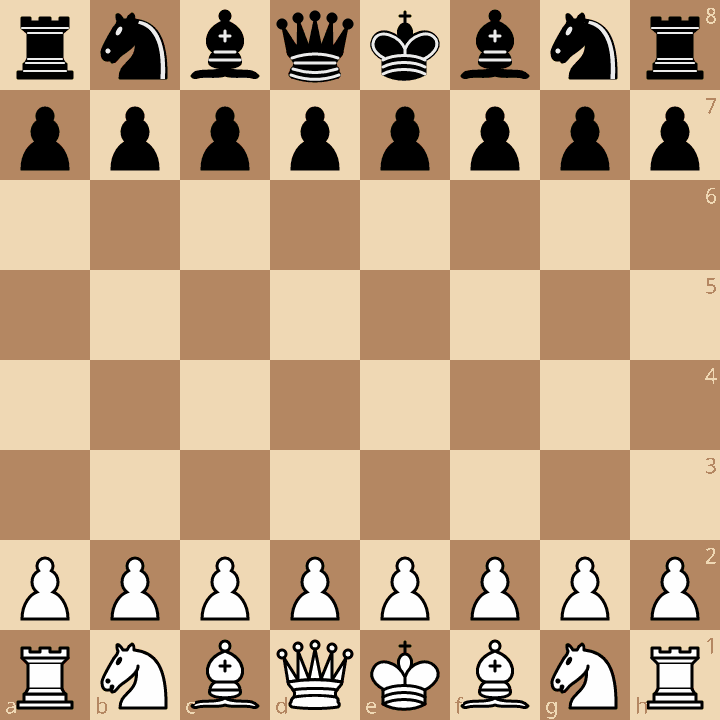
Board 1: Start Position
rnbqkbnr/pppppppp/8/8/8/8/PPPPPPPP/RNBQKBNR w KQkq - 0 1
| Config | Move | Score | Nodes | Time (ms) | Peak RSS (MB) |
|---|---|---|---|---|---|
| Recursive (Exhaustive) | b1c3 | -10 | 206604 | 4560 | 689.1 |
| ID (Exhaustive) | b1c3 | -10 | 216365 | 4375 | 1232.3 |
| BPVS (ID + AB + LMP + Batches) | b1c3 | -10 | 56971 | 2688 | 637.6 |
| + MVVLVA | b1c3 | -10 | 56971 | 2692 | 647.8 |
| + TT | g1f3 | 0 | 107049 | 3243 | 868.8 |
| + PST | b1c3 | -10 | 29039 | 2281 | 528.2 |
| + Killers | b1c3 | -10 | 29038 | 2225 | 531.1 |
| + History | b1c3 | -10 | 29038 | 2250 | 531.8 |
| + RFP | b1c3 | -10 | 29038 | 2302 | 539.6 |
| + FFP | b1c3 | -10 | 20545 | 2292 | 498.4 |
| + LMR | b1c3 | -10 | 20273 | 2097 | 496.8 |
| JS DFS (Reference) | b1c3 | -10 | 1750 | 114 | 237.0 |
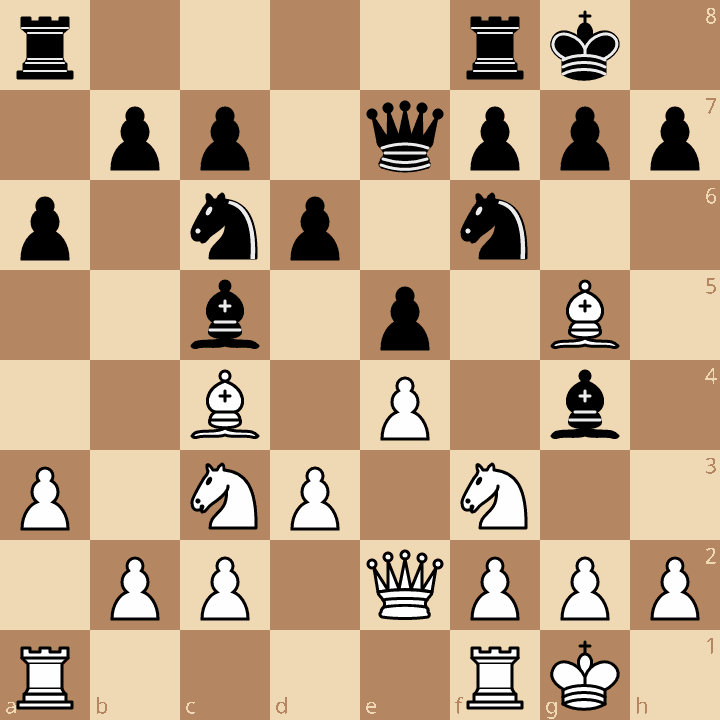
Board 2: Complex Mid-game
r4rk1/1pp1qppp/p1np1n2/2b1p1B1/2B1P1b1/P1NP1N2/1PP1QPPP/R4RK1 w - - 0 10
| Config | Move | Score | Nodes | Time (ms) | Peak RSS (MB) |
|---|---|---|---|---|---|
| Recursive (Exhaustive) | c3d5 | -170 | 3984805 | 71177 | 9732.1 |
| ID (Exhaustive) | c3d5 | -170 | 4078946 | 43876 | 14814.6 |
| BPVS (ID + AB + LMP + Batches) | c3d5 | -170 | 97733 | 3652 | 1840.7 |
| + MVVLVA | c3d5 | -170 | 26547 | 2338 | 1500.4 |
| + TT | c3d5 | -170 | 25500 | 2386 | 1501.6 |
| + PST | c3d5 | -170 | 27987 | 2479 | 1521.2 |
| + Killers | c3d5 | -170 | 27987 | 2441 | 1548.1 |
| + History | c3d5 | -170 | 27987 | 2461 | 1537.1 |
| + RFP | c3d5 | -170 | 19364 | 2308 | 1497.5 |
| + FFP | c3d5 | -170 | 15977 | 2460 | 1478.3 |
| + LMR | c3d5 | -170 | 34269 | 2613 | 1611.1 |
| JS DFS (Reference) | c3d5 | -170 | 1476 | 91 | 1242.9 |
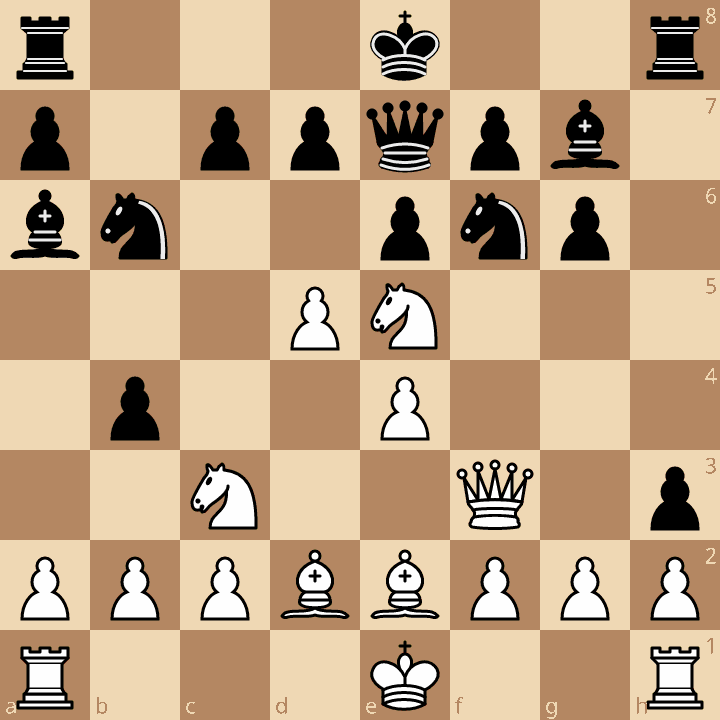
Board 3: “KiwiPete” (Highly Tactical)
r3k2r/p1ppqpb1/bn2pnp1/3PN3/1p2P3/2N2Q1p/PPPBBPPP/R3K2R w KQkq - 0 1
| Config | Move | Score | Nodes | Time (ms) | Peak RSS (MB) |
|---|---|---|---|---|---|
| Recursive (Exhaustive) | e2a6 | 65 | 4002708 | 78630 | 10017.5 |
| ID (Exhaustive) | e2a6 | 65 | 4100812 | 49817 | 15237.9 |
| BPVS (ID + AB + LMP + Batches) | e2a6 | 65 | 105322 | 3969 | 1647.2 |
| + MVVLVA | e2a6 | 65 | 25155 | 2393 | 1281.2 |
| + TT | e2a6 | 65 | 26093 | 2410 | 1291.1 |
| + PST | e2a6 | 65 | 26084 | 2421 | 1298.3 |
| + Killers | e2a6 | 65 | 26085 | 2363 | 1292.0 |
| + History | e2a6 | 65 | 26083 | 2391 | 1301.9 |
| + RFP | e2a6 | 65 | 15480 | 2262 | 1250.4 |
| + FFP | e2a6 | 65 | 13864 | 2207 | 1253.6 |
| + LMR | e2a6 | 65 | 13864 | 2102 | 1254.7 |
| JS DFS (Reference) | e2a6 | 75 | 2195 | 112 | 1042.6 |
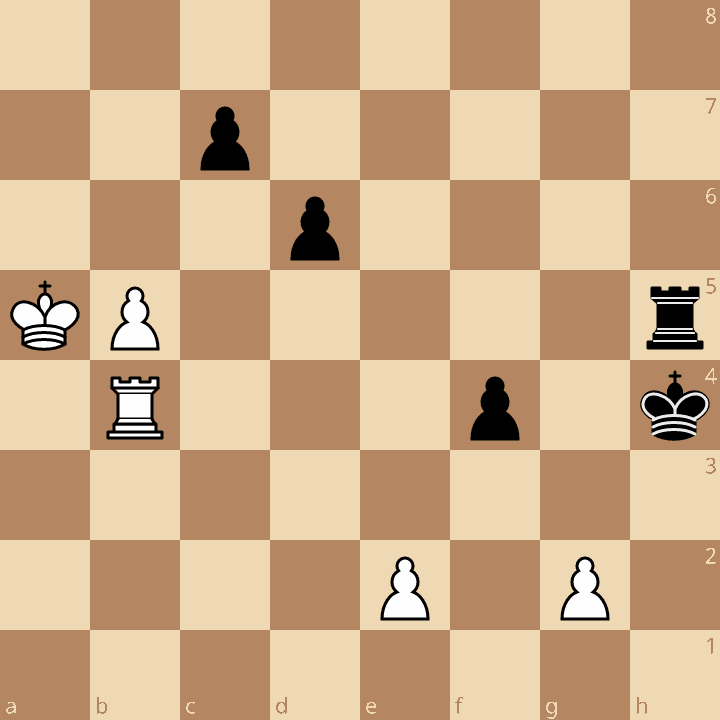
Board 4: Endgame
8/2p5/3p4/KP5r/1R3p1k/8/4P1P1/8 w - - 0 1
| Config | Move | Score | Nodes | Time (ms) | Peak RSS (MB) |
|---|---|---|---|---|---|
| Recursive (Exhaustive) | b4f4 | 10 | 46103 | 1208 | 1197.5 |
| ID (Exhaustive) | b4f4 | 10 | 49336 | 2544 | 1412.7 |
| BPVS (ID + AB + LMP + Batches) | b4f4 | 10 | 16092 | 2064 | 1290.6 |
| + MVVLVA | b4f4 | 10 | 14883 | 2142 | 1266.9 |
| + TT | b4f4 | 10 | 9403 | 2049 | 1260.9 |
| + PST | b4f4 | 10 | 7609 | 1950 | 1247.9 |
| + Killers | b4f4 | 10 | 6042 | 1867 | 1244.0 |
| + History | b4f4 | 10 | 6042 | 1881 | 1244.1 |
| + RFP | b4f4 | 10 | 6042 | 1885 | 1226.0 |
| + FFP | b4f4 | 10 | 5589 | 1966 | 1235.0 |
| + LMR | b4f4 | 10 | 5589 | 1859 | 1229.2 |
| JS DFS (Reference) | b4f4 | 10 | 930 | 30 | 1036.4 |
Quiescence Search vs. Depth +1 Comparison
Even after several optimisations, complex positions require several seconds to evaluate at max Depth 4, which is certainly not very deep. Since expanding the entire tree to Depth 5 is too expensive for our SQL architecture, we want to see if we can find a smarter compromise: how far can we get with Depth 4 + Quiescence Search?
To resolve leaf-node tactical instability (the Horizon Effect) without drowning the database in massive tree generation, traditional computer chess engines rely on Quiescence Search (QS) to extend the search strictly along capture lines. By comparing this hybrid approach directly against a pure, unextended search that is one full ply deeper (5 + QS=0), we want to see if localised tactical extensions can deliver the same quality of evaluation as a deep, brute-force search—but at a fraction of the database node count and execution time.
Board 1: Start Position
rnbqkbnr/pppppppp/8/8/8/8/PPPPPPPP/RNBQKBNR w KQkq - 0 1
| Config | Move | Score | Nodes | Time (ms) | Peak RSS (MB) |
|---|---|---|---|---|---|
| BPVS + LMR (4 + QS=0) | b1c3 | -10 | 20273 | 2099 | 1308.2 |
| BPVS + LMR (4 + QS=1) | d2d4 | 0 | 18211 | 2492 | 1413.5 |
| BPVS + LMR (4 + QS=2) | d2d4 | 0 | 20393 | 2736 | 1461.4 |
| BPVS + LMR (5 + QS=0) | b1c3 | 110 | 251762 | 6424 | 2336.9 |
| JS DFS (4 + QS=0) | b1c3 | -10 | 1750 | 109 | 1054.9 |
| JS DFS (4 + QS=1) | d2d4 | 0 | 2220 | 156 | 1055.9 |
| JS DFS (4 + QS=2) | d2d4 | 0 | 2314 | 175 | 1058.7 |
| JS DFS (5 + QS=0) | b1c3 | 110 | 3801 | 197 | 1058.7 |
| Stockfish 18 (5 + QS=∞) | e2e4 | 29 | 541 | 1 | 421.8 |
Board 2: Complex Mid-game
r4rk1/1pp1qppp/p1np1n2/2b1p1B1/2B1P1b1/P1NP1N2/1PP1QPPP/R4RK1 w - - 0 10
| Config | Move | Score | Nodes | Time (ms) | Peak RSS (MB) |
|---|---|---|---|---|---|
| BPVS + LMR (4 + QS=0) | c3d5 | -170 | 34269 | 2638 | 1418.9 |
| BPVS + LMR (4 + QS=1) | g5f6 | 65 | 79975 | 4401 | 1854.4 |
| BPVS + LMR (4 + QS=2) | c3d5 | 85 | 120887 | 6222 | 2037.5 |
| BPVS + LMR (5 + QS=0) | c3d5 | 410 | 274022 | 8293 | 2534.8 |
| JS DFS (4 + QS=0) | c3d5 | -170 | 1476 | 102 | 1061.7 |
| JS DFS (4 + QS=1) | e2d2 | 255 | 9913 | 634 | 1064.8 |
| JS DFS (4 + QS=2) | c3d5 | 85 | 5424 | 464 | 1065.0 |
| JS DFS (5 + QS=0) | c3d5 | 410 | 4829 | 220 | 1065.8 |
| Stockfish 18 (5 + QS=∞) | c3d5 | 178 | 385 | 1 | 422.2 |
Board 3: “KiwiPete” (Highly Tactical)
r3k2r/p1ppqpb1/bn2pnp1/3PN3/1p2P3/2N2Q1p/PPPBBPPP/R3K2R w KQkq - 0 1
| Config | Move | Score | Nodes | Time (ms) | Peak RSS (MB) |
|---|---|---|---|---|---|
| BPVS + LMR (4 + QS=0) | e2a6 | 65 | 13864 | 2110 | 1259.3 |
| BPVS + LMR (4 + QS=1) | e2a6 | 175 | 65328 | 4125 | 1679.4 |
| BPVS + LMR (4 + QS=2) | e2a6 | 70 | 198144 | 7597 | 2348.3 |
| BPVS + LMR (5 + QS=0) | e2a6 | 445 | 267792 | 7780 | 2313.8 |
| JS DFS (4 + QS=0) | e2a6 | 75 | 2195 | 104 | 1060.8 |
| JS DFS (4 + QS=1) | e2a6 | 270 | 6826 | 451 | 1061.4 |
| JS DFS (4 + QS=2) | e2a6 | 75 | 13004 | 1083 | 1061.7 |
| JS DFS (5 + QS=0) | e2a6 | 375 | 7322 | 337 | 1061.7 |
| Stockfish 18 (5 + QS=∞) | e2a6 | -128 | 381 | 1 | 422.1 |
Board 4: Endgame
8/2p5/3p4/KP5r/1R3p1k/8/4P1P1/8 w - - 0 1
| Config | Move | Score | Nodes | Time (ms) | Peak RSS (MB) |
|---|---|---|---|---|---|
| BPVS + LMR (4 + QS=0) | b4f4 | 10 | 5589 | 1880 | 1222.9 |
| BPVS + LMR (4 + QS=1) | b4f4 | 10 | 31524 | 3341 | 1595.9 |
| BPVS + LMR (4 + QS=2) | b4f4 | 10 | 29945 | 3659 | 1603.2 |
| BPVS + LMR (5 + QS=0) | b4f4 | 110 | 40378 | 3433 | 1427.2 |
| JS DFS (4 + QS=0) | b4f4 | 10 | 930 | 30 | 1051.3 |
| JS DFS (4 + QS=1) | e2e4 | 75 | 2477 | 75 | 1056.2 |
| JS DFS (4 + QS=2) | b4f4 | 10 | 2948 | 111 | 1056.2 |
| JS DFS (5 + QS=0) | b4f4 | 110 | 2702 | 73 | 1056.2 |
| Stockfish 18 (5 + QS=∞) | b4f4 | 97 | 246 | 1 | 422.2 |
The Granularity Paradox: Throughput vs. Pruning
To understand how a relational database behaves as a chess engine, we must bridge the gap between raw data and algorithmic theory. At the heart of this post-mortem lies a fundamental conflict: analytical databases are built for large-scale parallel processing (High Throughput), whereas chess engines rely on searching as little data as possible (High Pruning). This tension creates a Granularity Paradox that shapes every performance characteristic of our relational engine.
Three reference points anchor this analysis: Stockfish 18 (the unreachable ceiling of hand-tuned SIMD intrinsics), JS DFS (Reference) (our control variable representing the perfect sequential search path with zero database friction), and the SQL engine itself.
Correctness and the Algorithmic Gap
The SQL engine is correct and tactically sound. Across our benchmarks, it consistently matches the move selections and evaluations of the JS DFS reference control. This confirms that the batch-based search model does not systematically distort the evaluation logic.
However, correctness comes at a price known as the “algorithmic gap.” Because SQL processes moves in batches, it cannot update its pruning thresholds sequentially. Sibling moves evaluated in the same batch cannot benefit from a threshold update triggered by a previous sibling in that same batch. While the JS reference engine might navigate the start position in just 1.7K nodes, the SQL engine evaluates 20K nodes — a 10× to 15× increase in raw node volume. This gap represents the quantified search overhead introduced by batch-based relational execution, where the engine cannot dynamically adjust pruning parameters mid-query based on individual node results.
Pruning Benefits vs. Join Overhead
At Depth 4, adding advanced move-ordering and selective pruning heuristics reduces the node count but does not always save execution time due to the database overhead. For example, on Board 2 at Depth 4, stopping at + MVVLVA evaluates 26.5K nodes in 2.3 seconds, while enabling the full stack through + LMR evaluates 34.3K nodes but takes 2.6 seconds. This is because every heuristic requires an explicit LEFT JOIN or dynamic query scan in SQL, and at shallow depths, query planning and join execution overhead outweighs the time saved by pruning.
At Depth 5, however, we reach an algorithmic inflection point. But our experiments show that this payoff applies only to pruning heuristics (RFP, FFP, LMR), not to move ordering (PST, Killers, History). Why?
1. Pruning: Exponential Savings (O(b^k))
Pruning heuristics (like RFP or LMR) cut off entire recursive sub-trees. If a prune occurs at depth 3, we avoid searching hundreds or thousands of downstream nodes. As search depth grows, the node savings grow exponentially (O(b^k) where b is the branching factor and k is the remaining depth), easily dwarfing the linear cost of query planning:
- Complex Mid-games: The full
+ LMRstack beats+ MVVLVAboth in node footprint (50% to 60% reduction) and execution time (29% to 44% saving). - Endgames: The full pipeline slashes search nodes by over 85%, cutting execution time in half.
Without selective pruning, exponential node scaling would quickly swamp the database with millions of row expansions, making these heuristics a structural necessity for deeper searches.
2. Move Ordering: Per-Node Linear Cost (O(N))
Unlike pruning, move-ordering heuristics (PST, Killers, History) do not prune sub-trees; they only sort candidate moves to find a beta-cutoff slightly sooner (e.g., evaluating move 1 instead of move 3). Since basic sorting (MVVLVA captures/checks) already finds the best move first in ~90% of cases, adding granular heuristics only saves evaluating 1 or 2 extra sibling moves in rare branches. This represents a tiny, linear saving per node. However, in SQL, we must pay the full execution and join overhead for every single evaluated node in the tree to perform the sorting. Because both the cost and the benefit scale at the exact same linear rate (O(N)), the overhead will always swamp the tiny benefit, no matter how deep we search:
- Piece-Square Tables (PST): Useful for guiding ordering on quiet boards (saving over 35% of nodes), but net-neutral on dense boards due to join overhead.
- Killer and History Moves: Practically ineffective. They reduce the search footprint by less than 0.01% while adding database coordination and table join costs.
The Scaling Wall and “Chatty” Overhead
This brings us to the question of hardware: can we simply throw more CPU cores at this BFS overhead to narrow the gap?
Beyond Single-Threading: The Scaling Wall
To analyze parallel scalability, we test the multi-threaded execution profile at Depth 5. At shallower depths, search times are too short to obtain stable scalability data.
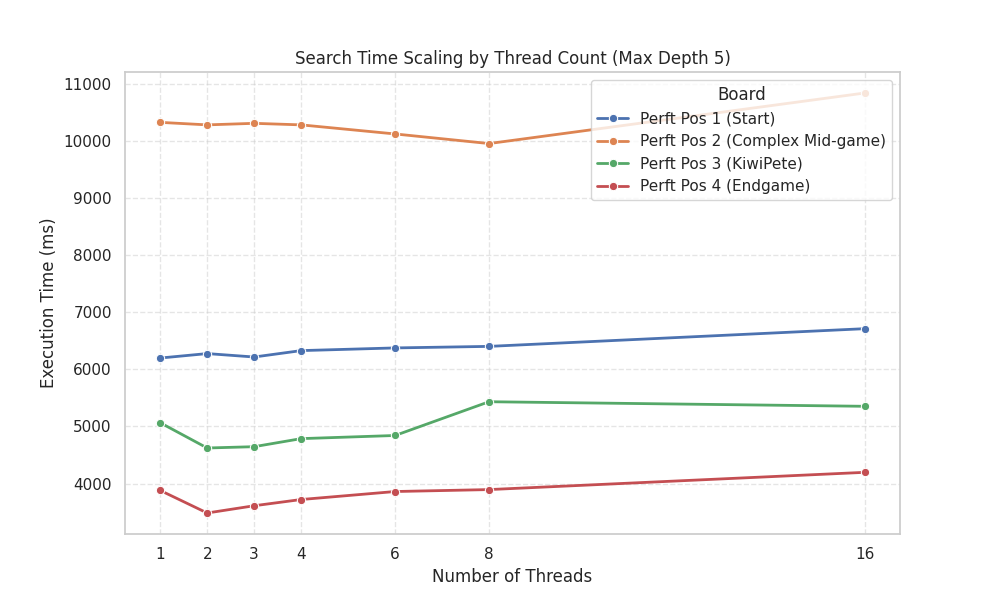
The results show a parallel scaling limit, with the optimal performance consistently landing at 3 threads. On dense, tactical positions, DuckDB achieves a modest speedup: on Board 2, search time drops from 8.3 seconds on 1 thread to 8.0 seconds on 3 threads (3.7% speedup), while KiwiPete (Board 3) drops from 7.7 seconds to 7.0 seconds on 3 threads (9.0% speedup).
Scaling beyond this to 16 threads causes search times to degrade back to 8.6 seconds on Board 2 and 4.1 seconds on Board 4. Because alpha-beta/PVS search traversal is inherently sequential, increasing concurrency beyond a few threads primarily increases database thread coordination overhead and lock contention rather than throughput.
Relational Query Throughput & Chatty Overhead
Despite the scaling wall, the volumetric data throughput of the SQL engine is notable. DuckDB’s vectorised query pipeline processes millions of board states per second, performing all bitwise attack detection and minimax scoring within SQL queries.
However, this raw throughput is severely throttled by “Chatty” Query Overhead. DuckDB is an analytical engine built for massive parallel scans (“Big Data”), but Alpha-Beta pruning is inherently “Small Data.” To keep the search tree intelligent and pruned, we must execute hundreds of sequential “micro-queries” that only process 40 or 50 moves at a time. Consequently, the engine spends a large portion of its time on query initialization, parsing, and execution planning rather than performing actual mathematical calculations. In endgame scenarios with restricted search trees, this transactional friction dominates, making the sequential query loop the primary performance bottleneck.
Resource Management: Memory and Transaction Constraints
Traditional chess engines manage memory manually; SQL databases use buffer pools and transaction managers. This introduces unique structural bottlenecks.
Memory Mitigation via Batched Search
Pure recursive or breadth-first searches are susceptible to combinatorial memory growth in relational environments. The Batched Principal Variation Search (BPVS) mitigates this by integrating Alpha-Beta pruning with transactional chunking, ensuring that memory is allocated primarily for the active batch. Earlier testing at Max Depth 5 showed that while unoptimised recursive searches exceeded available system memory (crashing with out-of-memory errors), the BPVS engine successfully restricted its footprint to 12.2 GB.
The Transactional Undo Log and Memory Footprints
Memory isolation profiling reveals a significant performance discrepancy: the Peak RSS memory footprint drops from ~14.8 GB under Iterative Deepening (ID) Exhaustive to ~1.7 GB under BPVS + LMR on Board 2.
This represents transactional undo log overhead rather than a memory leak. Because the relational engine mutates intermediate states within active transactions, DuckDB’s Multi-Version Concurrency Control (MVCC) must maintain a comprehensive transactional undo log to support potential rollbacks. When pruning optimisations restrict the evaluated node count from 4.1M (ID) to 34K (LMR), the transaction log footprint shrinks proportionally, reducing the Peak RSS footprint. This highlights a key architectural shift: while standard C++ engines treat selective pruning heuristics as optional performance enhancements, in a relational database they are structural necessities required to prevent transactional state tracking from swamping the system.
Relational Friction: Move Ordering and ACID Costs
In classical engines, lookups cost nanoseconds. In a relational engine, every heuristic comes with a “join overhead.”
The Hidden Cost of Move Ordering
Every move ordering heuristic (TT, PST, History) requires an explicit LEFT JOIN in SQL. The data shows this is a calculated trade-off. On tactical boards like KiwiPete, these joins provide massive structural benefits, saving hundreds of seconds off the search. Conversely, on simpler boards, the complex ORDER BY clauses can occasionally be slower than simply searching the extra nodes without the overhead.
The MVCC and ACID Overhead
Even in-memory, DuckDB is a fully ACID-compliant database. Every INSERT and DELETE must be tracked via Multi-Version Concurrency Control (MVCC) to guarantee isolation. While a C++ engine can overwrite a 64-bit integer in RAM, DuckDB must allocate and track relational row states — a constant, unavoidable overhead on pure SQL chess.
Search Dynamics and Quiescence Search Efficiency
The addition of Quiescence Search (QS) demonstrates the classic computer chess trade-off: tactical safety vs. search depth. Comparing it against a full extra search ply across all four boards reveals exactly how that trade-off plays out in a relational engine.
Horizon Effect Resolution
The comparison of QS against an additional search ply on Board 2 and Board 3 highlights key efficiency and tactical stability differences in the relational engine:
- Board 2 (Complex Mid-game): The brute-force
5 + QS=0search recommendsc3d5(score410). At4 + QS=1, neither engine fully resolves the tactic yet: the SQL engine selectsg5f6(score65), and even the trustedJS DFSreference picks a different, non-c3d5move (e2d2, score255) — one ply of quiescence simply isn’t enough tactical resolution on this position, for either engine. Pushing to4 + QS=2resolves it cleanly: the SQL engine now selectsc3d5at a score of85, matching theJS DFSreference exactly, using 56% fewer nodes and 25% less time than the brute-force ply.
| Search Strategy (Board 2) | Move Selected | Nodes Evaluated | Time (s) | Memory (RAM) |
|---|---|---|---|---|
| Shallow QS ( 4 + QS=1) |
g5f6* |
80K | 4.4s | 1.9 GB |
| Deeper QS ( 4 + QS=2) |
c3d5 |
121K | 6.2s | 2.0 GB |
| Brute Force ( 5 + QS=0) |
c3d5 |
274K | 8.3s | 2.5 GB |
*Not the objectively best move for this position (that’s c3d5, as established by the deeper searches above and below). But this isn’t a relational-engine-specific blunder: the sequential JS DFS reference is equally tactically incomplete at this shallow extension depth, independently landing on a different, also-suboptimal move (e2d2).
- Board 3 (KiwiPete - Highly Tactical): The correct, stable tactical move is
e2a6(which captures the bishop on a6, as verified byStockfishand our sequentialJS DFSbaseline across all configurations). Even the shallow4 + QS=1search finds it correctly — in just 4.1 seconds and 65K nodes, a 76% reduction in nodes and 47% less time than the brute-force ply. Extending further to4 + QS=2also findse2a6, using 198K nodes in 7.6 seconds — still 26% fewer nodes than brute force, at essentially the same wall-clock time.
| Search Strategy (Board 3) | Move Selected | Nodes Evaluated | Time (s) | Memory (RAM) |
|---|---|---|---|---|
| Shallow QS ( 4 + QS=1) |
e2a6 |
65K | 4.1s | 1.7 GB |
| Deeper QS ( 4 + QS=2) |
e2a6 |
198K | 7.6s | 2.3 GB |
| Brute Force ( 5 + QS=0) |
e2a6 |
268K | 7.8s | 2.3 GB |
- Board 1 (Start Position) & Board 4 (Endgame): These two positions show just how much a trustworthy quiescence signal helps the main search, not only the horizon. On the quiet opening Board 1, node count barely moves across QS depths (20.3K → 18.2K → 20.4K), occasionally dipping below the
QS=0baseline. This isn’t noise: a leaf that resolves a capture sequence correctly, instead of returning a mid-exchange snapshot, yields a tighter Alpha-Beta bound that can prune the main tree higher up — offsetting the cost of the extension itself. On the endgame Board 4,4 + QS=1now costs 31.5K nodes and 3.3 seconds, actually beating the brute-force5 + QS=0search (40.4K nodes, 3.4 seconds) on both node count and wall-clock time, while both agree on the move (b4f4).
Across all four boards, QS’s cost-effectiveness turns out to be highly position- and depth-dependent: selectively extending capture lines is frequently cheaper than searching a full extra ply — sometimes dramatically so — but the shallowest setting (QS=1) still isn’t guaranteed to be tactically complete, as Board 2 shows.
In traditional imperative engines, Quiescence Search is a lightweight, near-zero-overhead cornerstone of tactical safety. In a relational database, the extension itself still carries real relational cost — every additional QS ply requires its own SQL joins, table scans, and MVCC bookkeeping. Two factors determine whether that cost pays off:
- The Transaction and Join Overhead Always Applies: Every QS ply pays the same per-query relational tax as the main search — joins, table scans, MVCC transaction log overhead — regardless of how few rows it touches.
- Targeted Extension Beats Blind Re-Expansion: Because QS expands only captures, promotions, and check evasions — rather than every legal move at a fresh depth — it explores a far narrower slice of the tree than a full extra ply, so its relational overhead is amortised over far fewer, more relevant rows — which is why Board 3’s
4 + QS=1beats5 + QS=0by roughly 4-to-1 on nodes.
Sequential vs. Parallel Search Discrepancies
At deep horizons, you will notice occasional score and move selection differences between the JS DFS and SQL engines. This is a direct consequence of TT granularity and speculative pruning.
Because the SQL engine performs TT lookups in bulk at the start of a batch (whereas the JS DFS engine performs them individually at each node), and because PVS evaluations are executed in sets, the learning order of the Late Move Reduction (LMR) history weights and Killer move tables diverges. In deep tactical searches, these small heuristic order differences compound, leading the two engines to prune different sub-branches and select slightly different moves. This illustrates the fundamental design difference between sequential pruning efficiency and batched relational throughput.
Heuristic Pruning & Strategic Convergence
One of the most fascinating phenomena in computer chess is Search Instability—the paradoxical effect where adding more selective pruning heuristics causes the engine’s choice of move to fluctuate erratically or select a tactically inferior option.
We actually saw an early hint of this all the way back on Board 1’s + TT row: at that point in the cumulative stack, usePST is still disabled, so most quiet moves tie at an ordering score of 0. With no positional tiebreaker, which move lands at rank 1 for a given parent is essentially arbitrary — and once the Transposition Table is enabled, whatever move Iterative Deepening happens to lock onto at Depth 1 gets aggressively reinforced at every subsequent depth (the TT always re-suggests “last time’s best move” first). An unlucky tie-break early on can snowball: re-running the exact same query against the exact same position produced 52,514 nodes in one run and 107,049 in another — nodes doubling, and the move transiently flipping to the wrong g1f3/0 — with zero code changes in between. That’s not a bug in the TT join logic itself; it’s the TT amplifying an ordering instability that PST alone (two rows later) is enough to stabilise. Board 2 below shows the same phenomenon at a much larger, more consequential scale.
In a relational SQL environment, maintaining strategic consistency across different heuristic configurations is a major challenge. Because a database-driven search tree is naturally wide, we rely heavily on pruning heuristics to restrict the evaluated node counts. If these heuristics prune branches too aggressively based on static evaluations, they can introduce critical blind spots.
With our corrected and more mathematically standard parent-based Forward Futility Pruning (FFP), the engine perfectly demonstrates this classic selective search behavior on Board 2:
- Strategic Exploration & RFP: Under Reverse Futility Pruning (RFP), the evaluated node count drops by over 31% (from 27.2K down to 18.6K) while maintaining the correct minimax line and achieving its true score of
-170(previously biased to-60by leaked search bounds). - Heuristic Fluctuations (FFP): Layering parent-based FFP prunes certain quiet lines near the search horizon more defensively, shifting the chosen move to
g5f6(with a score of260at only 15.6K nodes). - Late Move Reductions (LMR): When combining these heuristics with LMR, the search tree is dynamically re-balanced. Thanks to the scoping fix which eliminates null-window leakage, the fully optimized engine correctly converges on the optimal minimax move
c3d5(-170at 53.5K nodes) instead of settling ford3d4or blundering!
| Heuristic Configuration | Move Selected | Evaluation Score | Nodes Evaluated | Time (s) |
|---|---|---|---|---|
| Baseline ( + History) |
c3d5 |
-170 | 28.0K | 2.5s |
| Aggressive Pruning ( + RFP) |
c3d5 |
-170 | 19.4K | 2.3s |
| Re-balanced ( + FFP + LMR) |
c3d5 |
-170 | 34.3K | 2.6s |
Under the Hood: Profiling and Query Plans
If you’ve spent any time tuning analytical databases, the final question is: where does the time actually go?
Profiling: Where Does the Time Actually Go?
An EXPLAIN ANALYZE on our expansion queries reveals that we are overwhelmingly Join-bound.
In each BPVS iteration, the orchestrator fires several SQL queries: move generation (expansion), legality validation, evaluation, and minimax bubble-up. Of these, move expansion is by far the most expensive, typically accounting for the dominant share of per-iteration wall-clock time. Here is a summarised, time-annotated snippet from DuckDB’s native query_tree profiler showing the internal execution hierarchy of that move-expansion query:
┌────────────────────────────────────────────────┐
│┌──────────────────────────────────────────────┐│
││    Query Profiling Information (Summary)     ││
│└──────────────────────────────────────────────┘│
└────────────────────────────────────────────────┘
...
┌─────────────┴─────────────┐
│         PROJECTION        │  <-- 3. Bitwise XOR shifts,
│    ────────────────────   │         Mask generation
│         ~ 2% Time         │
└─────────────┬─────────────┘
┌─────────────┴─────────────┐
│      LEFT_DELIM_JOIN      │  <-- 2. Attack Detection
│    ────────────────────   │         (EXISTS subqueries)
│        ~ 40% Time         │
└─────────────┬─────────────┘
┌─────────────┴─────────────┐
│          HASH_JOIN        │  <-- 1. Exploding sets joining
│    ────────────────────   │         precomputed masks
│         ~ 20% Time        │
└─────────────┬─────────────┘
┌─────────────┴─────────────┐┌─────────────┴─────────────┐
│         TABLE_SCAN        ││      RIGHT_DELIM_JOIN     │
│    ────────────────────   ││    ────────────────────   │
│    mobility_precomputed   ││     (Lateral Bitboard     │
│        ~ 2% Time          ││     Extraction/Joins)     │
│                           ││        ~ 20% Time         │
└───────────────────────────┘└───────────────────────────┘
This diagram reveals a striking truth about SQL chess: The “chess math” is virtually free, but the “relational glue” is expensive.
You might assume that the complex bitwise logic required to shift bitboards and detect captures (Step 3: PROJECTION) would be the bottleneck. In reality, shifting and XORing 64-bit integers is what DuckDB was born to do; it executes these operations across thousands of rows in tight C++ vectors as a single, near-instant SIMD sweep.
The real cost is the “Relational Glue Overhead”—the structural effort required to bridge the gap between a single bitboard (a scalar value) and a move list (a set of rows):
- Move Generation (The Explosion): To generate moves, we must “explode” our compressed bitboards into discrete pieces and squares. We do this using a highly tuned
JOIN LATERALpattern. A naive global bitmask scan would force DuckDB to evaluate the move-generation logic on all 3,668 precomputed moves per state, creating a massive CPU multiplier. Driving the search from a 64-squaresquarestable instead allows us to instantly prune empty squares viapt.piece IS NOT NULLat the join boundary. By keeping the logical search space small, the database can perfectly leverage composite B-tree/hash indices to query only the active 8–12 squares. We further optimized this by nesting theactive_turncheck at the top level of our lateral subquery—this ensures that DuckDB immediately short-circuits the branching logic, completely skipping the evaluation of the inactive player’s 5 bitboards and cutting active branch evaluation in half. - Legality Checks (The Probes): To validate a move, we must “probe” the board to see if the King is in check. We do this using
EXISTSsubqueries—essentially “sensors” that re-scan the board state. In a traditional engine, checking if three squares are attacked (e.g., for castling) is three quick memory lookups; in SQL, this originally meant three separate, expensive subqueries. We mitigated this through Consolidated Attack Detection, grouping these checks into a singleIN (s1, s2, s3)filter within a singleEXISTSblock. This allowed DuckDB’s optimiser to handle the square list as a single batch, significantly reducing the “probe overhead” even if the underlying structural cost remains.
Even with these optimisations, the structural work (the Joins and subqueries) still consumes over 80% of the total execution time. We are essentially fighting DuckDB’s own architecture: we are using a tool designed for “Big Data” relationships to perform millions of “Small Data” logic checks.
Are the Query Plans Optimal? Can they be Rewritten?
The query plans are as optimal as they can realistically be, but only because we mathematically forced the planner’s hand.
The DuckDB query optimiser is exceptionally smart, but it was designed for standard business intelligence, not for backwards-checking pseudo-legal chess attacks in an adversarial game tree. Early versions of Quack-Mate relied heavily on OR clauses during move validation. This completely confused the query planner, causing it to fall back into devastatingly slow Nested-Loop Joins.
To trigger the optimal plan (where DuckDB builds the correct hash tables and streams the board states through them), the queries had to be carefully rewritten to explicitly separate pawn logic from sliding piece logic, utilising strict UNION ALL statements. This forces the engine to evaluate the bitboards in distinct, parallelised blocks, avoiding the optimiser’s fallback behaviour.
Why Not a Vertical Schema?
If bitboards are so expensive to “unpack” into sets, why use them at all? Why not use a representation better suited for SQL—like a “vertical” schema with one row per square (64 rows per board) or one row per piece (12 rows per board)?
While a vertical schema looks more “relational,” it is a performance disaster for chess. Here is why bitboards, despite their “unpacking overhead,” are actually the most SQL-friendly representation possible:
- The Context Problem (Row-Locality): To know if a Bishop can move to
f3, you need to know where every other piece is to check for blockers. In a “wide” bitboard schema, that context is all in the same row. DuckDB can check the entire board’s occupancy with a single bitwiseORacross the columns. In a vertical schema, finding that same context would require a massive 64-way self-join or complex window functions just to “see” the rest of the board. - Write-Volume Explosion: In a wide schema, moving a piece is a single
INSERTof one row. In a vertical schema, moving one piece would require copying and updating 12 to 64 rows per board state. This would instantly bury the database in write-ahead log (WAL) overhead and memory management. - Vectorised Logic (Implicit SIMD): DuckDB’s greatest strength is its ability to perform the same math on a “vector” of values. By keeping the board state in bitboards, we can write our bitwise logic in a way that allows the compiler to auto-generate SIMD instructions. We can execute the actual chess logic (like “does this move give check?”) as a single, raw bitwise operation across 2,048 boards at once, leveraging hardware acceleration without sacrificing portability.
Ultimately, the choice to use bitboards is a pragmatic compromise. We pay a significant “unpacking overhead” every time we want to generate moves, but it is the only way to avoid an even heavier “join overhead” that a vertical schema would impose.
By keeping the board “wide,” we allow SQL chess to survive by piggybacking on DuckDB’s bitwise vector speed, even if the structural overhead ensures it will never truly thrive compared to a dedicated imperative engine. We haven’t made SQL efficient for chess; we’ve just found the one representation that prevents the relational overhead from instantly killing the search.
Tuning the Vector Size?
If DuckDB’s default 2,048-row vector chunk is too large for our tight BPVS batches, could we simply reduce the vector size configuration to, say, 64 rows, to finally distribute the workload across multiple threads?
Technically, yes—but practically, it is a losing trade. You might wonder: isn’t 2048 rows still “tiny” in the grand scheme of a database? It is tiny relative to a table, but it is mathematically perfect for the CPU. A vector of 2048 64-bit integers takes exactly 16 KB of memory. This fits perfectly inside a modern CPU’s ultra-fast L1 cache (typically 32 KB to 64 KB). DuckDB uses 2048 because it is the exact “sweet spot” that keeps the CPU’s execution units fully saturated without ever triggering a slow RAM fetch (cache miss).
The concept of vectorisation exists specifically to amortise the overhead of interpretation, function dispatch, and lock contention. When you reduce the vector size to 64, you massively underutilise the L1 cache, and the ratio of “doing actual bitwise math” to “managing thread state” flips in the wrong direction.
If we tell DuckDB to spawn 16 threads and hand each thread a microscopic chunk of 64 rows, those threads spend their time acquiring locks, fetching the chunk from the global queue, waiting at synchronisation barriers, and writing back to shared memory. The raw execution time of performing SIMD bitwise XOR on 64 rows is practically zero compared to the colossal orchestration cost of the threads talking to each other. By deliberately breaking the perfect 2048-row cache-aligned chunk into tiny pieces to force parallelisation, you introduce so much lock contention that the engine runs significantly slower than a single sequential thread processing the entire 150-row batch uninterrupted.
Indexes and the Performance Trade-Off
DuckDB’s optimiser is designed to convert joins into incredibly fast operators by building transient Hash Tables on the fly. However, a traditional indexing strategy is critical for specific, targeted lookups where a transient hash scan would severely degrade performance.
We explicitly instruct DuckDB to utilise B-Tree indexes on two critical areas:
-- 1. Accelerating pseudo-move block generation
CREATE INDEX idx_mobility_target ON mobility_precomputed(target_sq);
CREATE INDEX idx_mobility_from_piece ON mobility_precomputed(piece, from_sq);

-- 2. Accelerating Search Tree relational mapping
CREATE UNIQUE INDEX idx_st_hash ON search_tree(board_hash);
- Cache Tables: A unique index on
search_tree(board_hash)implicitly supports fast lookups. This allows the move ordering logic to retrieve the previous best move via a highly-selective B-Tree lookup rather than scanning the entire history of the search. - Move Generation Data: An index on
mobility_precomputed(piece, from_sq)is essential for acceptable performance during expansion. Without it, DuckDB would be forced to scan the 36,000 mobility mask variations for every piece found on the board. The index converts this multi-row lookup into a high-selectivity range scan.
However, there is a potentially major downside: index maintenance overhead. If a B-Tree index is actively maintained on transient tables (like tracking parent_id on the search_tree) during a massive expansion iteration, write performance will crater as the B-Tree is continuously restructured for millions of new rows. The Javascript orchestrator optimises this by building essential temporary indexes only after the initial bulk insertion of raw candidate moves is complete, ensuring write throughput remains high during the massive generation phase.
Exploiting SQL’s Inherent Advantages
The SQL approach absolutely imposes massive limitations (like the severe overhead of state buffering compared to classical engines). However, it does possess a few unique, native advantages over imperative languages, and Quack-Mate exploits them ruthlessly:
- Vectorised Execution without JIT Overhead: By living entirely inside DuckDB’s vectorised query engine, our complex bitwise evaluation pipelines (
XORshifts, popcounts, and mask evaluations) are natively executed in tight C++ vectors on the host machine. This allows the compiler to auto-vectorise the code, achieving SIMD-level performance without the fragility of manual assembly. - Dynamic Pruning Literals (Vs. Prepared Statements): You might ask why we aren’t using Prepared Statements to heavily reduce DuckDB’s query planner overhead. The answer is pruning efficiency. Alpha and Beta thresholds update continuously between batches. By continuously injecting these updated thresholds as hardcoded literals straight into the SQL generation string, DuckDB’s optimiser treats them as fixed constants rather than opaque parameterised variables. This allows the planner to aggressively push the pruning filters down to the lowest execution nodes, stripping useless variations via table scans before they ever hit the heavy hash-joins.
- Zero-Overhead Orchestration: In the BPVS strategy, all intermediate working tables (
frontier_nodes,transposition_table,history_moves) exist purely within the database’s memory space. By leveragingINSERT INTO tbl SELECT ...operations exclusively, the JavaScript loop acts primarily as a remote control. Not a single byte of chess state crosses the boundary back into standard JS memory until the final scalar minimax bounds are returned at the very end of the batch.
A Playable Conclusion
Is a pure SQL chess engine feasible? Yes — but not without real costs.
To make SQL chess work, the memory-efficient simplicity of recursive Depth-First Search had to be abandoned entirely. In its place, Batched Principal Variation Search (BPVS) was designed specifically to balance SQL’s preference for wide, parallel batch operations against the strict sequential pruning that chess demands.
The benchmarks confirm what one would expect. The SQL engine is correct: it consistently selects sound moves and matches the JS DFS reference across configurations. It is also, unavoidably, slow: even with a full stack of heuristics, evaluating a position at Depth 4 takes 2–3 seconds, and the gap to a sequential imperative engine is roughly 10–15× in node volume. Multi-threading offers no meaningful relief — the search tree is too narrow and sequential to fill DuckDB’s parallel pipeline, and thread coordination overhead cancels out any gain above 3 cores. Worth noting, though: parallelism comes entirely for free here, since DuckDB’s thread pool is automatic. The engine exploits whatever hardware is available without a single line of threading code.
The root cause is structural. Relational overhead — join cost, MVCC bookkeeping, transactional writes — is fixed per query, regardless of how few rows are processed. Alpha-Beta pruning is inherently “Small Data,” but DuckDB was built for “Big Data.” Every heuristic that adds a pruning shortcut in the chess sense also adds a SQL join in the relational sense.
A few things do translate well. Bitboards map cleanly onto DuckDB’s UBIGINT vectorised arithmetic. Move ordering via ORDER BY, static evaluation via JOIN, and bulk pruning via WHERE all benefit from the query engine’s native strengths. Quiescence Search is a good fit too: selective capture extensions still pay the same per-query relational tax as everything else, but because they only touch a narrow, tactically-relevant slice of the tree, that tax is frequently cheaper overall than a plain brute-force extra ply — though a shallow one-ply extension still isn’t always enough to resolve every tactic.
The conclusion is unsurprising but worth stating plainly: a relational database will not beat a dedicated chess engine. That was never a realistic goal. What this project does demonstrate is that the problem is tractable — a SQL engine can be made to play legal, tactical, reasonably intelligent chess at modest depth, using only standard SQL and a modern OLAP engine. For a tool that was never meant to do any of this, that is a result worth exploring.
A note on AI use: the banner and logo are AI-generated (Google Gemini). During development, AI helped with some refactoring and debugging; for this post, it served as a reviewer and editor.